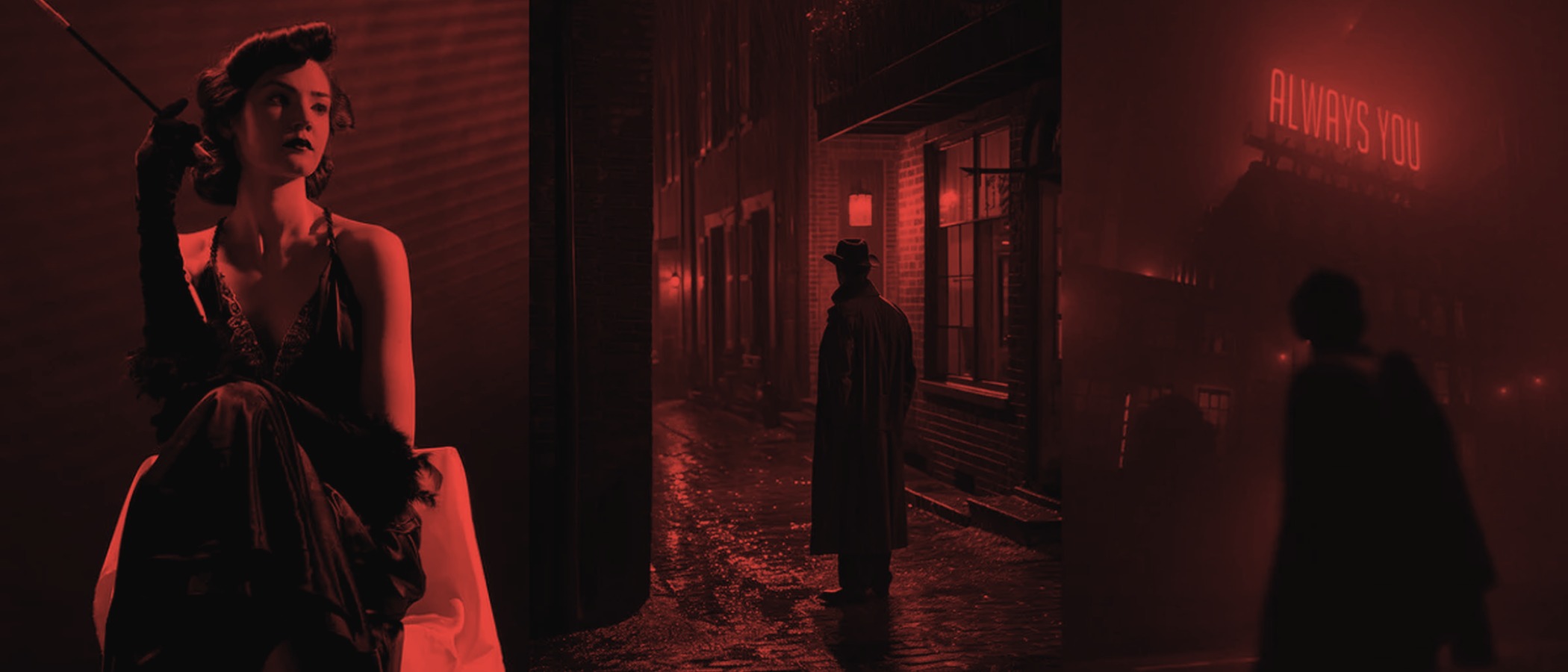
Los Angeles gets about fifteen inches of rain a year. In Double Indemnity it never stops, because Billy Wilder had the crew hose the streets down before every night exterior so the tarmac would throw the streetlights back at the camera. Fred MacMurray lights a cigarette on a wet pavement outside a house he should not be visiting, and the smoke goes up past his hat brim into the dark. Nothing has happened yet. You already know he is finished.
That is the thing about noir: the look is not a style laid over the story, it is the story told in light. Rain because the world is slippery, shadow because half of every face is lying, cigarettes because everyone in it is slowly killing themselves and knows it. Eighty years on, Blade Runner, Se7en and Drive are still using the same grammar because nobody has found a better one. Here is what each part of it is actually saying.
The Practical Origins of the Look
Let's start with the boring truth before we get to the romantic stuff: film noir looked the way it did partly because of budget constraints. The original noir cycle - roughly 1941 to 1958 - was dominated by B-movies. These weren't prestige pictures. They were cheap, fast, and dark, in every sense.
Low-key lighting hid cheap sets. Night shooting meant you didn't need expensive location permits. Rain on a soundstage was cheaper than building a convincing daytime street. Smoke diffused light beautifully, softening edges and creating depth on flat, underfunded sets. The aesthetic that defined an entire genre was born, in part, from not having enough money to light things properly.
Cinematographers like John Alton and Nicholas Musuraca turned necessity into art. Alton's work on The Big Combo and T-Men essentially invented modern chiaroscuro lighting for cinema. He didn't have money, so he had shadows instead. And shadows, it turns out, are infinitely more interesting than light.
Rain as Emotional Architecture
Rain in film noir isn't weather. It's a state of mind.
Think about what rain does to a film frame. It makes surfaces reflective - every puddle becomes a mirror, doubling the neon, stretching the light, creating a world that feels unstable and fluid. It isolates characters, trapping them under awnings and in doorways, forcing physical proximity and whispered conversations. It makes the world hostile: cold, wet, uncomfortable, a place you endure rather than enjoy.
In Blade Runner - the greatest neo-noir ever made, fight me - it rains constantly, and it's never explained. Is it climate change? Industrial pollution? Does it matter? The rain creates Los Angeles 2019 as a place of perpetual discomfort. Deckard is always wet, always cold, always slightly miserable. The rain is his emotional state made manifest.
In Se7en, David Fincher insisted it rain in virtually every exterior scene. He wanted the city to feel like it was rotting. The rain isn't cleansing - it's corrosive. It makes everything worse. The crime scenes are worse because they're wet. The streets are worse because they're slippery. The entire world is worse because nothing ever dries.
Classic noir understood this instinctively. In The Big Sleep, Out of the Past, Touch of Evil - the rain arrives when the plot darkens, when the trap is closing, when the protagonist's choices narrow to nothing. It's pathetic fallacy at its most effective: the world weeps because the story demands it.
Cigarettes as Character Work
Before the Surgeon General ruined everything, cigarettes were the single most versatile prop in cinema. A cigarette could convey more about a character in five seconds than a page of dialogue. How they lit it, how they held it, how they exhaled - it was all performance.
Consider: Humphrey Bogart in The Maltese Falcon, cigarette perpetually between his fingers, smoke wreathing his face while he calculates his next lie. The cigarette is armour. It gives him something to do with his hands, creates a screen of smoke between him and whoever's trying to read his expression. It's a stalling tactic, a power move, and a character detail all at once.
Or: Barbara Stanwyck in Double Indemnity, letting Fred MacMurray light her cigarette in a gesture so loaded with sexual tension it should have required a chaperone. The act of lighting someone's cigarette was noir's version of a sex scene - intimate, controlled, and absolutely devastating.
Lauren Bacall, asking Bogart for a light in To Have and Have Not: "You know how to whistle, don't you?" The cigarette is the excuse. The light is the invitation. The smoke is the aftermath. An entire seduction in thirty seconds, and the cigarette makes all of it possible.
Smoke also does incredible things on camera. It catches light, creates volume, adds texture to otherwise flat compositions. A room full of smoke looks lived in, dense with history and secrets. It's why every noir detective's office looks like a fog bank with a desk in it - the smoke tells you this is a place where bad decisions are made regularly.
Shadows and the Moral Gradient
The shadow work in film noir is inseparable from its moral universe. Classic Hollywood cinema - the "white telephone" pictures, the musicals, the romances - was brightly lit because its moral world was clear. Good guys were good. Bad guys were bad. Everything was visible and therefore comprehensible.
Noir rejected that. Its characters existed in moral grey areas, and the lighting reflected it. Half-lit faces. Venetian blind shadows striping across bodies like prison bars. Characters swallowed by darkness, visible only as silhouettes. The visual grammar said: you cannot fully see these people because you cannot fully know them.
The Third Man is the masterclass. Carol Reed and cinematographer Robert Krasker shot Vienna in canted angles and extreme shadow, creating a world where nothing is level and nothing is trustworthy. When Orson Welles appears - fifty minutes in, lit from below by a sudden light, smirking like the devil himself - the shadows have been preparing you for him. He's the darkness made flesh.
This visual philosophy has never gone away because it works on a primal level. We are afraid of the dark. We are suspicious of what we can't see. Noir weaponises that instinct and aims it at the characters themselves.
The Neo-Noir Inheritance
Modern filmmakers who work in the noir tradition understand that you can't just replicate the look - you have to understand why it works. The best neo-noirs aren't pastiche; they're translations.
Chinatown (1974) inverted the visual language by setting its corruption in blazing Los Angeles sunshine - the darkness is metaphorical, not literal, which makes it more disturbing. L.A. Confidential (1997) mixed noir shadows with postwar glamour to create a world that looks gorgeous and rotten simultaneously.
Drive (2011) gave us neon where noir had streetlamps, synth where it had saxophone, but the emotional architecture is identical: a solitary man, a woman he can't have, a world that punishes everyone, and long stretches of atmospheric silence where the visuals do the talking.
Denis Villeneuve's Blade Runner 2049 may be the most visually ambitious neo-noir ever attempted. Roger Deakins' cinematography takes every noir convention - rain, fog, shadow, isolation - and scales it to IMAX proportions. The "sea wall" sequence is essentially a noir alley expanded to the size of an ocean. It's staggering.
Why It Still Works
Film noir's visual language endures because it maps onto something true about human experience. Life is ambiguous. People are unknowable. The world does feel hostile and confusing. Bright, even lighting tells you everything is fine. Noir lighting tells you nothing is fine, and it never was, and the best you can hope for is to make it through the night.
The rain keeps falling because sadness doesn't stop. The cigarettes keep burning because people need something to hold onto. The shadows keep growing because the darkness in people isn't a phase - it's a feature.
Every filmmaker who puts rain on a window, smoke in a room, or shadow on a face is speaking a language that was codified eighty years ago by underpaid craftspeople working on B-movies. They couldn't afford sunshine, so they invented a visual philosophy that told the truth about human nature.
Not bad for a bunch of cheapskates working in the dark.
Related Articles
- Greatest Opening Credits Sequences Ever Made - Visual storytelling before the story even starts
- The Golden Age of Movie Posters - When art sold cinema
- Why Practical Effects Will Always Beat CGI - The case for physical filmmaking
- From Shadows to Streaming - A no-bullshit history of film
- Movie Scores That Outgrew Their Films - When the music becomes bigger than the movie