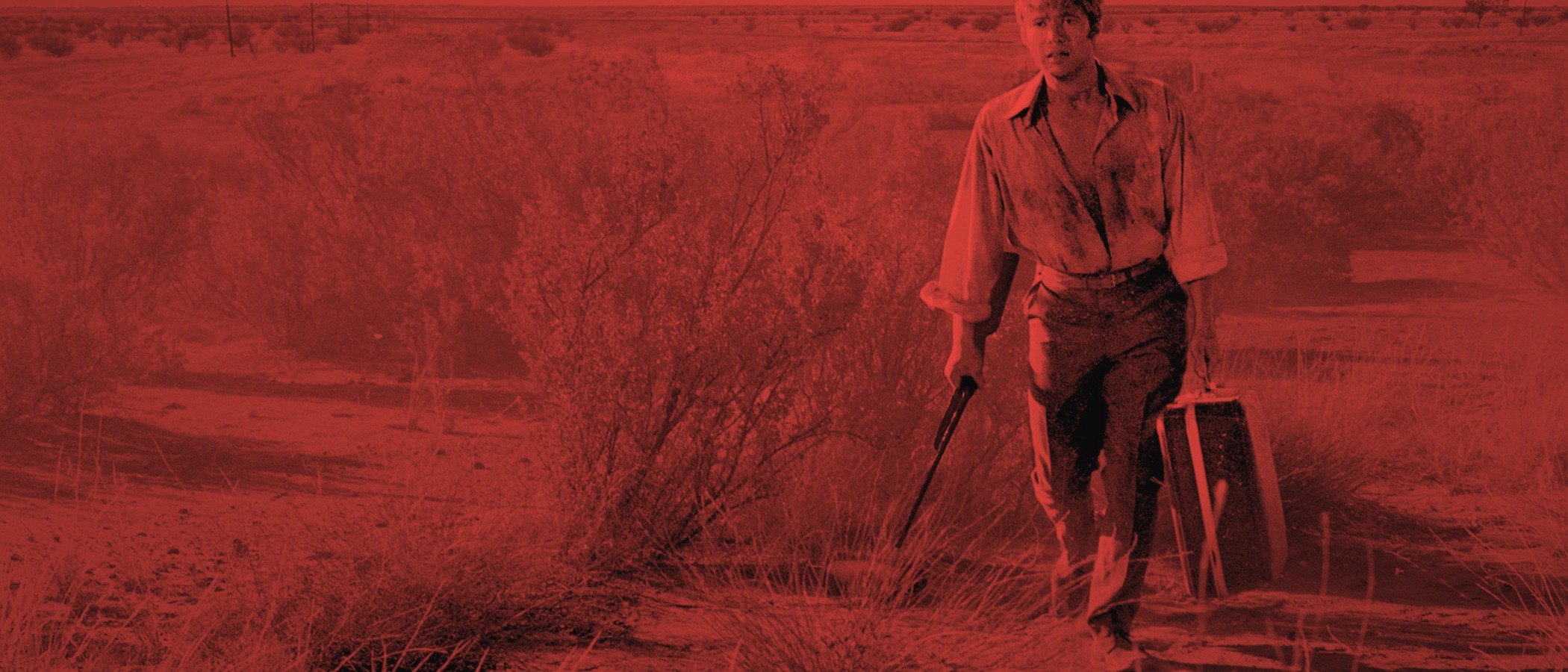
John Grant is a schoolteacher in a one-room school in the middle of nowhere, bonded to the education department by a thousand-dollar deposit he cannot afford to lose. It is the Christmas holidays. He is going to Sydney to see his girlfriend, and on the way he stops for one night in a mining town called Bundanyabba. The Yabba, the locals call it. Everyone likes the Yabba.
He has a beer with the local policeman. He has another. He finds a two-up game in the back of a pub and wins enough to pay off the bond. Then he goes back to win a little more. By the end of the weekend he has lost everything, drunk everything, shot things he did not want to shoot, and done something with a mad doctor played by Donald Pleasence that the film declines to show us. And everyone has been so hospitable.
A Canadian, an Englishman and the outback
Wake in Fright was directed by Ted Kotcheff, a Canadian who would later make First Blood and Weekend at Bernie's, which is a career. The star, Gary Bond, was English. The producers were American and the script was adapted from Kenneth Cook's 1961 novel by a Jamaican-born writer, Evan Jones. It was shot in Broken Hill, in New South Wales, in the summer of 1970, in heat the crew talked about for the rest of their lives.
The foreignness matters. Australians in 1971 had not made many films about themselves, and when they did they were polite. Kotcheff looked at the outback and saw a place where mateship was a trap, where refusing a drink was an act of violence, and where the sun did not so much shine as press down. The film is shot in colours that look like a hangover. It is one of the great pieces of horror cinema and there is not a single supernatural thing in it.
The hunt
The scene everyone talks about is the kangaroo hunt. Grant is taken out at night by the locals in a truck with a spotlight and the film shows, at length, what happens. Most of the footage was shot on a real professional hunt that the production followed, and the crew stopped filming when the shooters, drunk, began to miss. Kotcheff has said the RSPCA asked him to leave it in, as the most effective anti-hunting footage ever made. It remains the reason a lot of people cannot finish the film and the reason a lot of others cannot forget it.
Cannes, and then nothing
The film went to Cannes in 1971 in competition. Martin Scorsese saw it there and later said it left him speechless. Then it came out in Australia, where audiences reportedly stood up and shouted at the screen that this was not them, and it did no business. It was retitled Outback for Britain and America, did no business there either, and disappeared. By the eighties there were no prints. By the nineties there was not even a decent negative. A film that had played Cannes had, to all practical purposes, ceased to exist.
The search
Anthony Buckley had been the film's editor. In 1996 he started looking for it, on his own time, because it bothered him that something he had cut had vanished. It took him years. Leads went to a lab in London that had closed, to a vault in Dublin, to a warehouse in the United States. In 2002 he found the original negative and the sound elements in a shipping container in Pittsburgh, in a facility that had marked the cans "for destruction". They were a week or so from being burnt.
The restoration took the best part of seven years. The film was screened at Cannes again in 2009, in the Classics section, one of only two films ever to be selected twice, and it went back into Australian cinemas that year to the reviews it should have had the first time. Nick Cave called it the best and most terrifying film about Australia in existence. This time people agreed with him.
What it is actually about
The easy reading is that Wake in Fright is about Australia, and it is, but the reason it travels is that it is about what happens to a person who thinks he is better than the place he is standing in. Grant is a snob. He looks down on the miners and the barmen and the policeman, and the film's cruelty is that they are kind to him, endlessly, until the kindness has taken everything he had. The horror is not that the Yabba is savage. It is that Grant fits in perfectly.
Donald Pleasence, playing the doctor who has given up entirely and is living in a shack drinking whatever is put in front of him, is the film's ghost of Christmas future. He is the most frightening thing in it, and he is the only one who tells Grant the truth.
Where it sits now
It was the last film of Chips Rafferty, the big genial face of Australian cinema for thirty years, who plays the policeman and died before it opened. It is now on every list of the great Australian films and most lists of the great films about drinking. It has been remade as a television series, which nobody needed. And the fact that it exists at all is down to one editor who would not let it go.
Wake in Fright is on our films page and turns up on Frame a Day more than you would expect. If the frame is a pub interior in a colour that hurts, that is your answer. New to the Yabba?