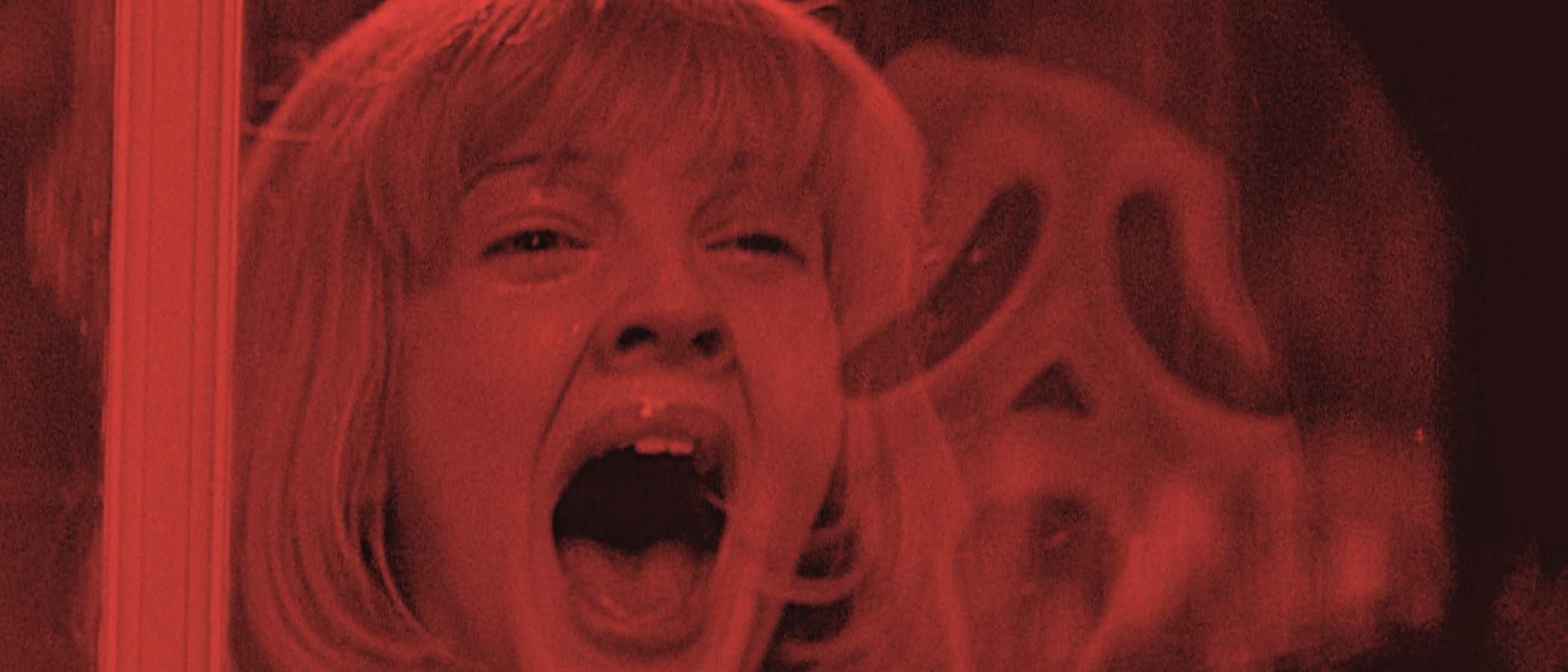
The last ten minutes of Halloween: Laurie Strode in a wardrobe with a coat hanger, Michael Myers on the other side of the slatted door. She does not win. She survives, which in 1978 was the most a woman in a horror film was allowed to do, and she survives specifically because she is the babysitter who stayed in with the kids while her friends went out to get killed. The rule was that clear. Drink, shag or wander off and you die; keep your head down and you might see the credits.
Carol Clover put a name to her in 1992, the Final Girl, and by then the type was already curdling. This is the story of how she went from surviving to fighting, from fighting to knowing she was in a horror film, and finally to being the monster, told through seven women: Sally, Laurie, Nancy, Sidney, Erin, Adelaide and Maxine. If you only know her from Scream, the interesting bit is what happened after.
The Origin: Sally Hardesty (The Texas Chain Saw Massacre, 1974)
Marilyn Burns as Sally Hardesty is the proto-Final Girl, and she's defined almost entirely by suffering. Sally doesn't outsmart Leatherface. She doesn't fight back in any meaningful way. She runs, she screams, and she survives through sheer, raw endurance. The film's final image - Sally laughing hysterically in the back of a pickup truck, drenched in blood, her mind visibly breaking - isn't triumph. It's survival at the cost of sanity.
Tobe Hooper's film is a masterpiece, but Sally isn't a character so much as a vessel for the audience's terror. She exists to experience horror on our behalf. Her survival isn't empowering - it's accidental, brutal, and bought at a terrible price. This is the Final Girl at her most reductive: alive, but barely.
The Template: Laurie Strode (Halloween, 1978)
Jamie Lee Curtis as Laurie Strode established the Final Girl template that would define the slasher genre for the next two decades. Laurie is studious, responsible, and notably virginal while her friends are having sex and getting murdered for it. Carpenter's morality is blunt: transgression equals death, virtue equals survival.
But there's more going on than prudish moralising. Laurie is also resourceful. She fights back with a coat hanger, a knitting needle, a kitchen knife - household objects turned weapons, the domestic turned violent. There's an argument that Laurie's survival isn't about purity but about awareness. She's the one who notices the shape in the hedges. She's the one who takes the threat seriously when everyone else dismisses it. In a genre built on characters making stupid decisions, Laurie makes smart ones.
Curtis would return to the role across four decades, turning Laurie into a multigenerational study of trauma. By Halloween Ends (2022), she's less Final Girl than Final Woman - scarred, hardened, and refusing to be defined by the worst thing that ever happened to her.
The Subversion: Nancy Thompson (A Nightmare on Elm Street, 1984)
Heather Langenkamp's Nancy Thompson took the Final Girl formula and actively deconstructed it. Nancy doesn't just survive Freddy Krueger - she studies him. She researches, she plans, she sets booby traps. She treats the supernatural threat like a problem to be solved rather than a fate to be endured. When the adults in her life fail her - and they fail her spectacularly - Nancy takes matters into her own hands.
Wes Craven was always the most intellectually engaged of the slasher directors, and Nancy reflects that. She's a Final Girl who thinks her way out, who refuses the passive role the genre assigns her. Her ultimate weapon isn't violence - it's turning her back on Freddy and denying him the fear he feeds on. It's a profoundly feminist gesture disguised as a horror movie ending.
The Meta Turn: Sidney Prescott (Scream, 1996)
Neve Campbell's Sidney Prescott is the first Final Girl who knows she's a Final Girl. Craven's Scream operates in a world where characters have seen slasher films and understand the rules. Randy literally lists them: don't have sex, don't drink, don't say "I'll be right back." Sidney exists in a genre-aware landscape and navigates it accordingly.
But Scream does something cleverer than simple meta-commentary. Sidney isn't a virgin. She has sex and survives. She's not passive or pure - she's angry, traumatised, and increasingly willing to fight back with a violence that matches her attackers'. By the time the franchise reaches its later instalments, Sidney is less a victim than a force of nature, returning each time with the weary competence of someone who's done this before and will do it again.
Sidney broke the mould by acknowledging it existed. After Scream, the Final Girl could never be innocent again - of the genre's rules or her own power within them.
The Reclamation: Erin (You're Next, 2011)
Sharni Vinson's Erin in Adam Wingard's You're Next is the moment the Final Girl stopped being a survivor and became a predator. When masked home invaders attack a family gathering, Erin - who, it turns out, grew up on a survivalist compound - doesn't hide, doesn't scream, and certainly doesn't wait to be rescued. She sets traps, arms herself, and systematically eliminates the attackers with a competence that's genuinely thrilling.
The film inverts the genre's power dynamics completely. The killers, who expect helpless victims, find themselves outmatched by a woman who is faster, smarter, and more violent than they are. Erin isn't surviving - she's winning. The Final Girl has become the action hero, and the shift is seismic.
The Revolution: Adelaide/Red (Us, 2019)
Jordan Peele's Us gives us a Final Girl who is simultaneously the monster. Lupita Nyong'o plays both Adelaide - the protective mother fighting to save her family - and Red, her doppelgänger from the underworld. The film's devastating twist reframes the entire Final Girl narrative: what if the survivor was the villain all along? What if survival itself is an act of violence?
Peele weaponises the archetype against itself. The Final Girl's survival instinct - her willingness to do whatever it takes - is revealed as something darker than heroism. Adelaide didn't just survive. She replaced. The boundary between victim and monster dissolves entirely, and the Final Girl concept is shattered into something far more complex and troubling.
The Modern Era: Maxine Minx (X / MaXXXine)
Mia Goth as Maxine Minx across Ti West's trilogy is the Final Girl as ambitious antihero. Maxine doesn't survive because she's virtuous - she survives because she refuses to be stopped. She's a porn actress, a fame-seeker, a woman with no interest in conforming to the genre's moral framework. Her survival isn't a reward for good behaviour. It's an act of will.
Goth's performance across the trilogy - and her dual role as Pearl in the prequel - represents the Final Girl's fullest evolution to date. She's sympathetic and ruthless, vulnerable and dangerous, a victim who becomes a star. The puritanical equation of the original slasher - virtue equals survival - has been completely inverted. Maxine survives because she wants it more.
Where She Goes Next
The Final Girl is no longer a trope. She's a tradition - one that each generation of horror filmmakers inherits and redefines. From Sally Hardesty's traumatised survival to Maxine Minx's ferocious ambition, the archetype has absorbed decades of feminist discourse, genre evolution, and cultural change. She's been passive, resourceful, meta-aware, predatory, monstrous, and triumphant. She's been every kind of woman horror can imagine.
The next evolution is anyone's guess. But if history is any guide, it'll be bolder, stranger, and more subversive than anything we expect. The Final Girl always survives. But how she survives - and what that survival means - keeps changing.
And that's what makes her the most important character in horror.
Related Articles
- Horror Movies That Are Actually Scary - The ones that genuinely terrify
- Movie Twist Endings Ranked - Cinema's greatest reveals
- Character Actors: Faces You Know, Names You Don't - The unsung heroes of cinema
- The Art of the Cold Open - First scenes that defined films
- Films That Were Too Ahead of Their Time - Movies the world wasn't ready for