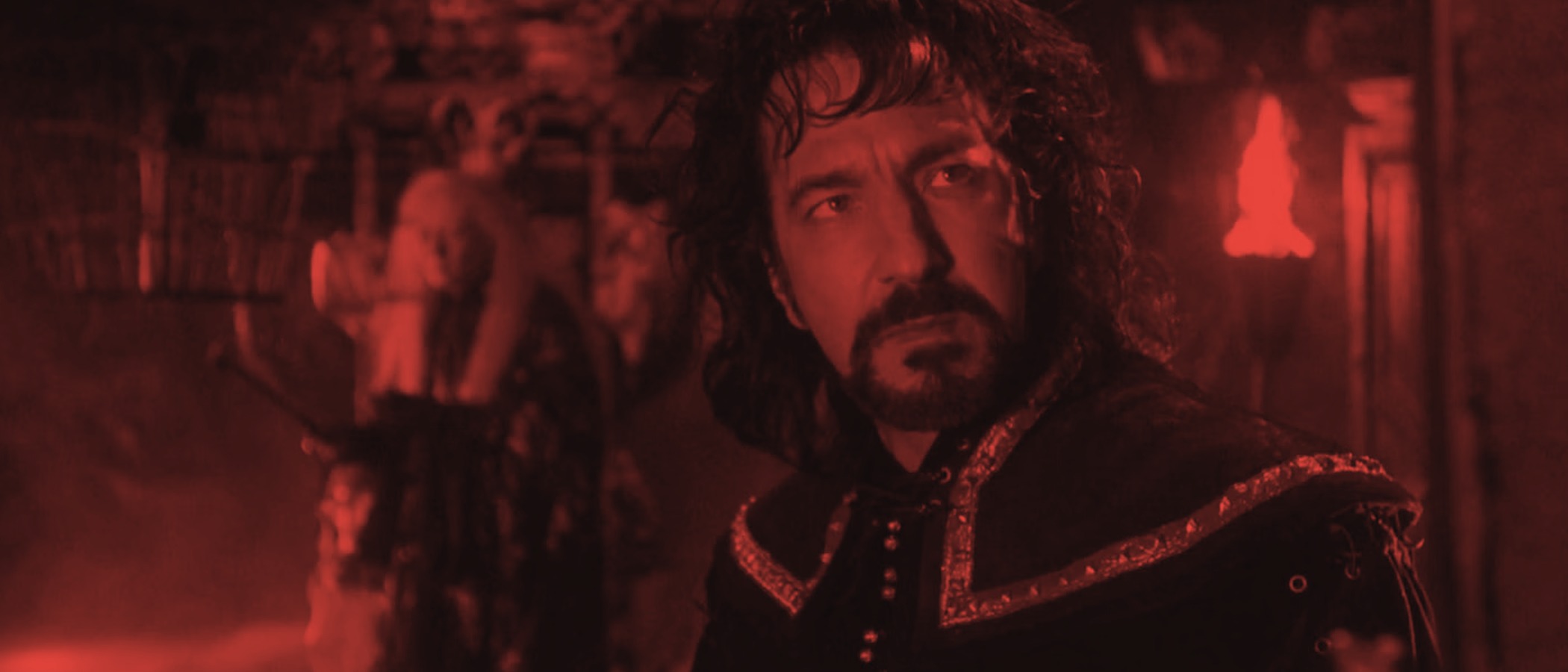
There's a particular kind of film where you find yourself physically leaning forward every time the antagonist appears and mentally checking your watch whenever the protagonist returns. Films where the villain isn't just better written or better performed than the hero - they're operating on a completely different frequency. Every frame they occupy crackles with an energy the rest of the movie can't match.
These aren't just great villains. These are performances so dominant they warp the entire film around them like a gravitational field. The hero becomes a supporting character in their own story, and honestly? We don't mind one bit.
Heath Ledger as The Joker (The Dark Knight)
We might as well address the elephant in the room first. Heath Ledger's Joker is the single greatest villain performance in cinema history, and if you disagree, you're wrong. Not "in my opinion" wrong. Factually incorrect. The man reinvented one of pop culture's most iconic characters so completely that every subsequent attempt - Jared Leto's cringe, Joaquin Phoenix's excellent but entirely different interpretation - exists in his shadow.
Every scene Ledger is in, the film elevates. The interrogation scene, the hospital scene, the pencil trick - Christian Bale gives a perfectly solid performance as Batman, and it doesn't matter even slightly. You're waiting for the clown. We all were. The tragedy is that Ledger never got to see what he'd created, but the performance endures as proof that a villain can define a film more completely than any hero ever could.
Anthony Hopkins as Hannibal Lecter (The Silence of the Lambs)
Here's a fun statistic: Anthony Hopkins is on screen for approximately sixteen minutes in The Silence of the Lambs. Sixteen. Out of a 118-minute film. And he won the Oscar. That's not a performance - that's a heist. Hopkins stole the entire movie in less time than it takes to watch an episode of a sitcom.
Every second he's on screen is electric. The stillness, the precision of his diction, the way he seems to be conducting the conversation like an orchestra - Jodie Foster is extraordinary as Clarice, and yet the film belongs to the man in the glass box. His screen time is so limited that each appearance feels like an event. You don't watch Lecter. You survive him.
Javier Bardem as Anton Chigurh (No Country for Old Men)
Javier Bardem walks through the Coen Brothers' West Texas like death itself - patient, methodical, and completely indifferent to human suffering. The coin toss scene at the petrol station is one of the tensest sequences ever filmed, and it's just two men talking. Chigurh doesn't raise his voice. He doesn't need to. The cattle bolt pistol and that insane haircut do all the threatening required.
Josh Brolin is excellent as Llewelyn Moss, the supposed protagonist, but the film keeps returning to Chigurh because the Coens understand what we understand: he's the one we can't look away from. When the film denies us a conventional hero-villain showdown, it's because Chigurh has transcended the genre. He doesn't need a final confrontation. He's already won.
Alan Rickman as Hans Gruber (Die Hard)
Bruce Willis is great in Die Hard. He's funny, he's relatable, he's bleeding from his bare feet. But Alan Rickman as Hans Gruber is the reason the film is rewatched every Christmas (yes, it's a Christmas film, fight me). Gruber is sophisticated, witty, immaculately dressed, and treating a hostage situation like a minor inconvenience at a board meeting. His reaction when the bearer bonds arrive - that little smile, that adjustment of the cuffs - tells you everything about a man who considers himself the smartest person in every room.
"Now I have a machine gun. Ho ho ho." That's not a villain line. That's poetry.
Christoph Waltz as Hans Landa (Inglourious Basterds)
The opening scene of Inglourious Basterds is twenty minutes of Christoph Waltz having a polite conversation with a French farmer, and it's one of the most terrifying sequences Tarantino has ever directed. Landa - "The Jew Hunter" - is charming, multilingual, complimentary, and absolutely going to find those people hiding under the floorboards. He knows it. The farmer knows it. We know it. And Waltz plays every beat of that awful knowledge with a smile that never quite reaches his eyes.
Brad Pitt's Aldo Raine is entertaining in a cartoonish way, but Waltz exists in a different stratosphere. He won the Oscar for this, and frankly they should have given him two.
Kathy Bates as Annie Wilkes (Misery)
Kathy Bates is so terrifying in Misery that she singlehandedly changed how people think about their most enthusiastic fans. Annie Wilkes - obsessive, volatile, capable of swinging from maternal warmth to volcanic rage in a single sentence - is the kind of villain who's frightening because she's recognisable. We've all met someone with that intensity, that desperate need to control. We just haven't been strapped to a bed by them.
James Caan does excellent work as Paul Sheldon, but he's essentially a prop for Bates to act against. The hobbling scene still makes people flinch decades later, and that's entirely down to Bates making Annie simultaneously pathetic and terrifying.
Daniel Day-Lewis as Bill the Butcher (Gangs of New York)
Scorsese's flawed epic about 19th-century New York gang warfare should belong to Leonardo DiCaprio. He's the protagonist, the emotional centre, the audience surrogate. But Daniel Day-Lewis shows up as Bill the Butcher and simply takes the film. Takes it like a man who takes what he wants and dares you to stop him.
Bill is theatrical, poetic, violent, and fascinatingly patriotic in a way that feels uncomfortably modern. Day-Lewis - who reportedly stayed in character between takes and sharpened knives for fun - delivers a performance so outsized it makes everything around it feel like a miniature. DiCaprio is a fine actor. In this film, he's wallpaper.
What Makes a Scene-Stealing Villain?
The common thread isn't volume or theatricality - it's specificity. Each of these performances has made choices so precise, so detailed, so lived-in that the character feels more real than the hero. The Joker's lip-licking. Lecter's thousand-yard stare. Chigurh's coin toss. These aren't acting choices - they're architectural decisions that build characters from the ground up.
There's also something fundamentally more interesting about villains. Heroes are constrained by morality. They have to be likeable, relatable, noble. Villains have no such restrictions. They can be funny, cruel, unpredictable, charismatic, repulsive - often all at once. The best actors understand this freedom and exploit it mercilessly.
Every film on this list proves the same uncomfortable truth: we don't really want the good guys to win. We want to be entertained. And nothing entertains like a villain who knows exactly what they're doing.
Related Articles
- Movie Villains Who Actually Had a Point - When the bad guys' logic was uncomfortably sound
- Why The Dark Knight Is Still the Greatest Superhero Movie - Ledger's Joker and beyond
- One-Scene Wonders - Supporting actors who stole entire films
- Method Actors Who Went Too Far - When commitment becomes obsession
- Character Actors: Faces You Know, Names You Don't - The unsung heroes of cinema