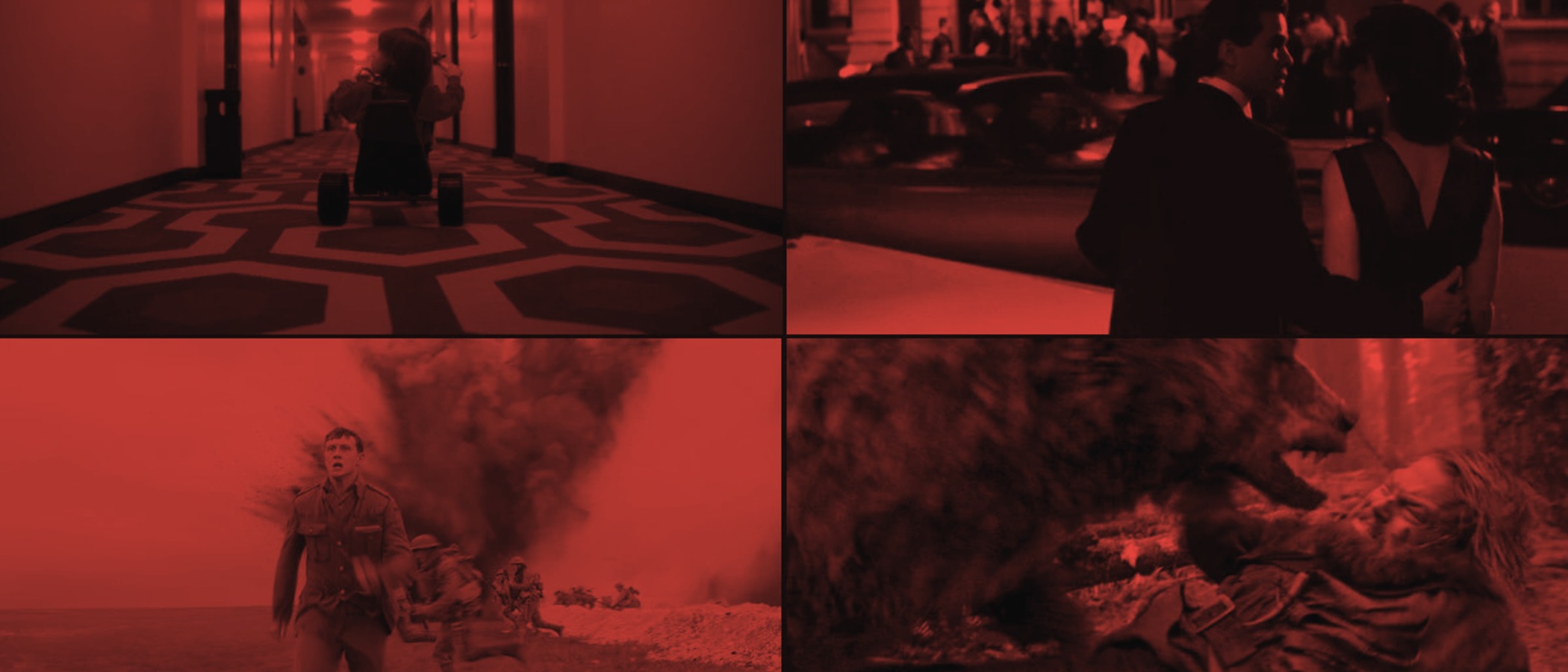
There's something almost perversely thrilling about a long take. The camera starts moving and doesn't stop. No cuts. No coverage. No safety net. Every actor has to hit every mark. Every extra has to be in the right place. Every technical element - lighting, sound, focus - has to work in unbroken concert. If one thing goes wrong at minute seven, you're going back to minute one.
The single take is cinema's high-wire act, and when it works, it produces sequences so immersive and visceral that conventional editing feels like cheating by comparison. These are the scenes that made cinematographers weep, actors swear, and audiences forget they were watching a constructed thing.
Touch of Evil (1958) - The Opening
Orson Welles invented the modern long take and immediately perfected it. Touch of Evil opens with a three-minute-and-twenty-second crane shot that follows a car with a bomb in its boot through the streets of a Mexican border town while simultaneously tracking Charlton Heston and Janet Leigh on foot. The camera moves through traffic, across borders, past pedestrians, creating an expanding web of tension that only breaks - literally and figuratively - when the car explodes.
This was 1958. No Steadicam. No digital trickery. Just Welles, a crane, and the audacity to open a film with a shot so technically ambitious it wouldn't be matched for decades. Universal Studios famously recut the film against Welles's wishes, but they couldn't touch this opening. It's untouchable because it's perfect.
Goodfellas (1990) - The Copacabana Shot
Scorsese's legendary tracking shot through the back entrance of the Copacabana nightclub is cinema's greatest flex. Ray Liotta takes Lorraine Bracco through the kitchen, down corridors, past staff, through the basement, and emerges into the club where a table materialises from nowhere. It's Henry Hill's world, and we're being given the VIP tour.
The genius isn't technical - it's narrative. The shot tells you everything about Henry Hill without a word of exposition. He doesn't queue. He doesn't use the front door. The world rearranges itself to accommodate him. When that table appears, carried over the heads of other diners, you understand power, privilege, and seduction more viscerally than any dialogue could convey. Scorsese said the shot was designed to show that "it seduced you, just as the lifestyle seduced Henry." Mission bloody accomplished.
Children of Men (2006) - The Car Ambush
Alfonso Cuarón and cinematographer Emmanuel Lubezki created a single-take car ambush that is, without exaggeration, one of the most technically astonishing shots in film history. The camera is inside the car with Clive Owen and his companions when they're attacked on a rural road. It swivels 360 degrees, capturing the chaos from every angle - a burning car rolling towards them, a motorcycle attack, a windshield cracking from a gunshot - all in one unbroken shot that feels like a documentary recording of a real event.
They rigged a special camera mount that could rotate inside the car while the seats folded down to allow movement. It was engineering as much as filmmaking. But the result transcends technique - it puts you physically inside the vehicle, trapped with the characters, unable to cut away. The violence isn't stylised. It's immediate, ugly, and real. That's what a long take can do that editing can't.
1917 (2019) - The Entire Film
Sam Mendes and Roger Deakins made an entire feature film designed to look like a single continuous shot. It isn't, of course - there are hidden cuts, digital transitions, and moments of darkness that disguise the edit points. But the effect is of a two-hour, unbroken real-time journey through World War I trenches, and it's extraordinary.
Critics were divided. Some called it a gimmick - a technical exercise masquerading as emotional storytelling. Others argued the continuous take was the point: war doesn't give you the luxury of a cut. You can't edit out the horrors. You experience them continuously, relentlessly, without relief. Whether you think it's genius or showing off, the no-man's-land sequence - with flares illuminating the ruins of a bombed-out town - is one of the most beautiful things ever committed to film.
Oldboy (2003) - The Corridor Fight
Park Chan-wook's hallway fight scene is the single take at its most brutal. Oh Dae-su fights his way through a corridor of thugs armed with nothing but a hammer and the furious energy of a man who's been imprisoned for fifteen years. The camera tracks sideways, like watching a 2D fighting game, as bodies accumulate and exhaustion sets in.
It's deliberately sloppy. The punches are messy, the movement is laboured, people get up and get knocked down again. This isn't choreographed elegance - it's a man in pain fighting through a wall of human beings by sheer force of will. The single take makes it feel real in a way that edited fight sequences never can. You feel the exhaustion because the camera is exhausted too. There's no relief of a cut, no reset. Just forward, always forward, until it's over.
Atonement (2007) - The Dunkirk Beach
Joe Wright's five-minute tracking shot across the Dunkirk beach is a technical marvel that manages to be both epic and intimate. The camera follows James McAvoy through the organised chaos of the evacuation - soldiers singing hymns, a ferris wheel being dismantled, horses being shot, a bandstand playing on - in one continuous movement that encompasses the entire scope of the disaster while never losing sight of one man's experience within it.
Wright rehearsed it for a full day and shot it in a single afternoon. Over a thousand extras, multiple set pieces happening simultaneously, and a Steadicam operator who deserved a knighthood. The result is a sequence that does in five minutes what most war films need two hours to achieve: it makes you feel the scale of human suffering.
Birdman (2014) - The Entire Film (Again)
Alejandro G. Iñárritu and Lubezki (him again) created a film that appears to take place in a single, unbroken shot through the backstage corridors of a Broadway theatre. Like 1917, there are hidden cuts, but the effect is of continuous, anxious, claustrophobic movement. Michael Keaton navigates the labyrinth of his own ego, and the camera follows him like a conscience he can't shake.
The long-take approach isn't just style here - it's theme. Riggan Thomson can't escape himself. There's no cut to provide distance, no edit to let him breathe. The camera is always there, always watching, always following. It's suffocating by design, and it's magnificent.
The Honourable Mentions
Rope (1948) - Hitchcock's experiment in real-time storytelling, disguising its cuts in camera moves to dark objects. Ahead of its time by half a century. Russian Ark (2002) - Alexander Sokurov's 96-minute genuine single take through the Hermitage Museum. No tricks. No hidden cuts. Just one shot, 2,000 actors, 300 years of Russian history. It's the purest expression of the form ever attempted. Gravity (2013) - Cuarón and Lubezki open with a 17-minute shot in zero gravity that's technically digital but viscerally real.
Why It Matters
The long take isn't a gimmick. At its best, it's cinema at its most honest - a refusal to manipulate through editing, a commitment to showing rather than constructing. Every cut is a choice, and every choice is a manipulation. The long take says: here it is, uninterrupted, unedited, uncompromised. Watch.
Not every film needs it. Most films shouldn't attempt it. But when a director and their cinematographer pull off a long take that serves the story - that makes you feel something editing couldn't - it's one of cinema's purest highs. No cuts, no safety net, no second chances.
Just the camera, the actors, and the terrifying, exhilarating commitment to getting it right.
Related Articles
- The Art of the Cold Open - First scenes that defined films
- Why Practical Effects Will Always Beat CGI - When real beats digital
- Behind the Scenes Disasters - When productions went spectacularly wrong
- Method Actors Who Went Too Far - Commitment taken to extremes
- The Enduring Madness of Apocalypse Now - When filmmaking became warfare