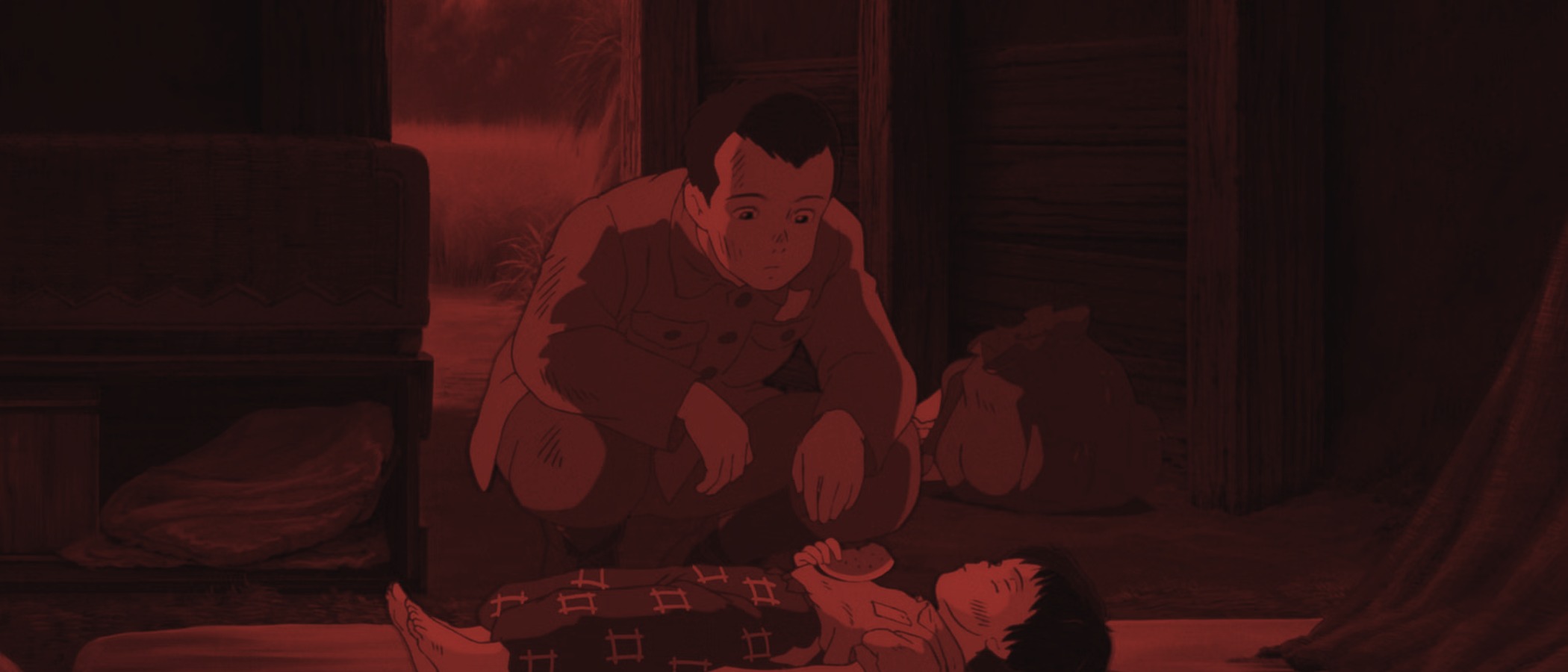
The mud rice balls come near the end. Setsuko has been lying in the shelter for days at this point. She's four. She stands up and begins making little round cakes out of dirt, pressing them into shapes with her swollen fingers, and offers them to her brother.
“Here,” she says. “Eat. There's plenty.”
Seita eats them, or pretends to, and that's one of the scenes in Grave of the Fireflies that's been picked apart for forty years by people who want to know how Isao Takahata made them cry. It's the small gesture. It's Setsuko not knowing she's starving. It's the child still trying to feed her brother when she has nothing to give.
But it's not what the scene is actually about.
There's a shot about twenty seconds earlier. Before Setsuko gets up. Seita is watching her. He has rice. Real rice. He has just come back from the black market and his pockets are full of food and he is sitting with his back against the wall of the shelter, and he is not feeding her.
That's the scene.
The whole film is Seita knowing
Grave of the Fireflies opens with Seita dead on the floor of a station in Kobe, and then cuts to his ghost, sitting up, watching his own body get dragged away. Takahata said in interviews that he didn't think of the film as anti-war. He thought of it as a story about a teenage boy who wanted to be left alone with his little sister, in their own private world, and got what he asked for.
The ghost frame matters more than people admit. This isn't a film narrated by a survivor. It's a film narrated by someone telling on himself.
Read the beats that way and the film shifts under your feet. Seita's aunt is cruel, yes. She is also correct. She is feeding them. They are children who lost their mother in a firestorm and their father to the navy, and they have no ration cards, and she is pregnant, and the war is about to be lost. She tells Seita, more than once, to do something. Sell the kimono. Get a job. Go to school. He refuses all of it because he cannot bear to be spoken to this way. He is fourteen. He was raised to think of himself as a small man of the house, a little officer in training, and now this woman wants him to be a boy again, or worse, a guest.
So he takes his sister and leaves.
He has one meaningful belonging: the bank book his mother left him. He does not touch it until Setsuko is already dying. He had the money the whole time.
The pride is the point
The most devastating line in the film is not a line. It's a moment near the end where Seita goes to the bank and is told, almost in passing, that Japan has surrendered. His father is dead. The fleet is gone. He stares at the teller and walks out into the rain holding three thousand yen in his hand, which is enough to have fed Setsuko for weeks. He runs. By the time he gets back to the shelter, she is already unconscious.
There is no gesture big enough for this. The film doesn't let him have one. He boils water. He cuts a watermelon. He puts a piece to her mouth. “Brother, thank you,” she says. Then she dies.
He could have done this three weeks ago. He chose not to.
That is why the ghost has to confess. He is not telling you a story about loss. He is showing you a ledger. Every thing he could have done is on one side, and his pride is on the other, and Setsuko is in between.
The fireflies aren't the metaphor
Everyone talks about the fireflies. They're in the title. There is a beautiful scene where Seita catches them and releases them into the shelter at night, and Setsuko giggles, and the next morning they are all dead and she is digging a little grave for them in the dirt. “Why do fireflies die so soon?” she asks.
But the fireflies aren't what the film is about. Read the ghosts in the final shot. Seita and Setsuko are sitting on a bench in modern Kobe, glowing, watching the lights of the city below. Setsuko is asleep in her brother's arms. He is looking straight at us.
He has been looking at us the whole film.
The ghosts are not at rest. They are not in a better place. They are watching the world move on from what happened and they need us to see it clearly. Seita cannot undo what he did. He cannot save her. All he can do is make you watch. The film's cruelty is not that they died. It is that he won't let himself off the hook.
Why this one hurts for specific reasons
A lot of films about grief leave you feeling sad and cathartic. This one does not. You leave Grave of the Fireflies angry, and if you think about it for a while, you realise the anger is at Seita. A boy. A child. A kid who refused help from a woman who was doing her best, who walked his sister into a cave and fed her one grain of rice at a time while he held onto the money.
The discomfort of realising that, and then sitting with the fact that he is a child, and that children do this, and that the adults around him failed him too, and that none of it gets to be simple, is what most war stories politely skip. Takahata refused to skip it. Most people miss the refusal.
The film was released on a double bill in 1988 with My Neighbour Totoro. Parents walked their children into the cinema expecting Miyazaki and got a body on the floor of a train station. Takahata said later he was sorry about the pairing. He did not apologise for the film.
What Setsuko knows
One more scene.
Setsuko and Seita are sitting on the beach. She is eating something, or pretending to. She asks him, “Why did mum have to die?”
He does not answer.
She says, “I know. She's under the ground, isn't she? With the flowers.”
This is not a four-year-old asking a question. This is a four-year-old offering her brother a story he can live with. She has worked out something the adults haven't told her, and she is checking his face to see if she has it right, and she wants him to be okay.
He can't look at her.
This is the thing about Setsuko. The film gives her moments that are exclusively about him. She is dying in half of them, and she is doing it gently, because she does not want him to feel bad. Seita's ghost knows this. He is not crying for his sister. He is standing in the light of his own death, holding the child who tried to spare him, and telling us what he did.
That is why it lands. It is not that he is sad. It is that he knows.