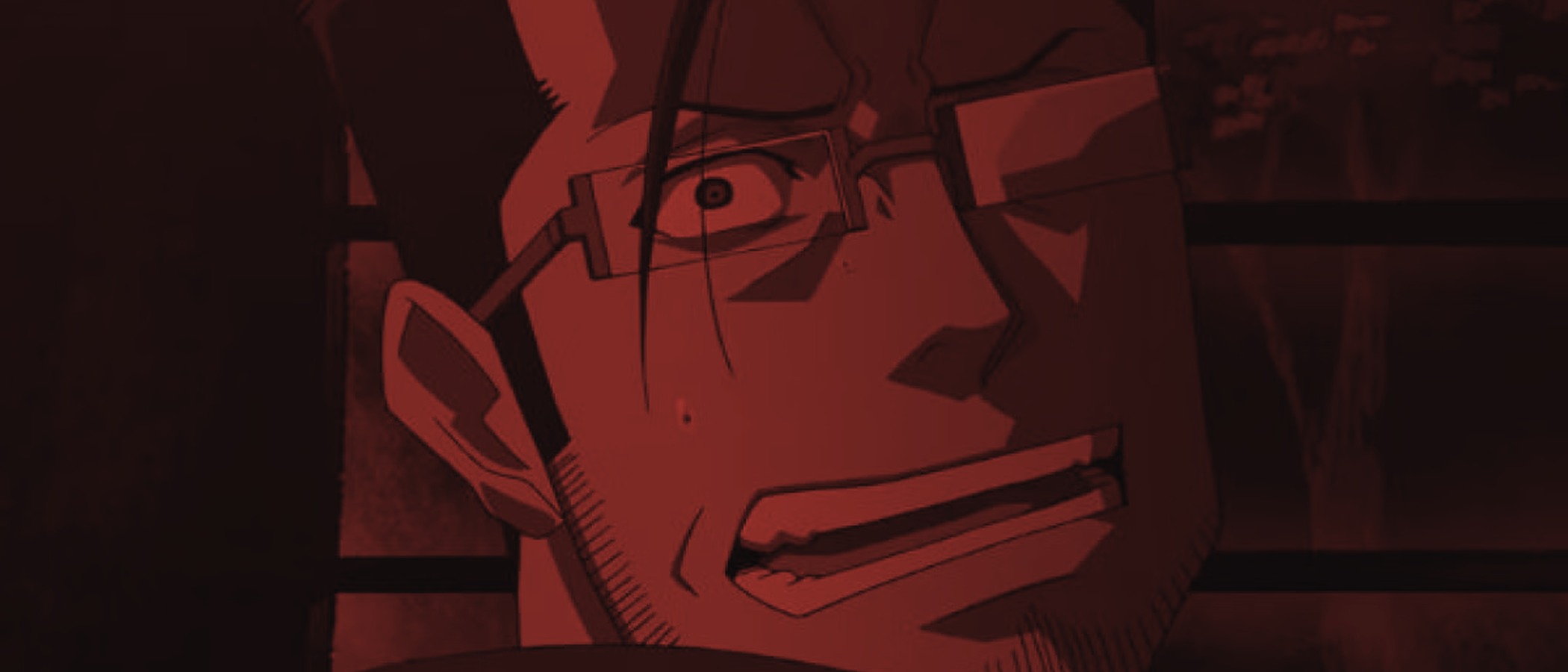
He pulls the photograph out in the middle of a war room. Fuhrer King Bradley is standing three feet away, Roy Mustang is briefing him, there's a map on the table, and Maes Hughes - Lieutenant Colonel, intelligence officer, Ishval veteran - interrupts everything to show a photo of his daughter eating a rice ball. Elysia. Three years old. Both her cheeks are full. He tells them she said the word "daddy" for the first time last week. He has already shown this photograph in this scene. He shows it again.
Mustang looks like he's going to kill him. Bradley laughs in a way that tells you nothing about what he thinks. The shot holds on Hughes, grinning, slightly sweaty, holding up a creased 4x6 print of a small girl with a mouth full of rice, and then the scene continues as if nothing happened.
That scene is Fullmetal Alchemist. The whole show is in it.
The man who wasn't built for this
Brotherhood runs for 64 episodes and by the end of it Hiromu Arakawa has assembled the kind of ensemble that most shonen series promise and never deliver: a cast of soldiers, scientists, old enemies, homunculi, ex-assassins and princes-in-exile who all believe slightly different things about what a life is worth. The show makes you watch every one of them make an argument and then pay for it.
Hughes is the odd one out.
He is not, in the structural sense, a protagonist. He is not a rival. He is not a villain. He does not have a secret bloodline or a lost limb or a tragedy driving him forward. He is the military's best intelligence officer. He's married to a woman named Gracia. They have a daughter. He carries photos of her in every pocket of his uniform and he will show them to you. He loves his wife in a way that the show treats as slightly embarrassing, in the way a happy man in a room of unhappy ones is slightly embarrassing. He is the only character in the cast who seems like he should be in a different story - a lighter one, a better one, one where his main problem is getting home for dinner.
And this is what makes him load-bearing.
He's the reason the world looks worth saving
The Elric brothers are trying to get their bodies back. Mustang is trying to scrub the blood of Ishval off his hands and become Fuhrer. Scar is trying to avenge a people. Olivier Armstrong is trying to hold a border. Everyone in Brotherhood is aiming at something with teeth in it.
Hughes is not. Hughes is trying to get home.
His plot role, in intelligence terms, is to figure out what the homunculi are doing to the country. He's the one who pieces together the map - the transmutation circle, the sacrificial points, the hollow promise of Amestris. He is the man in the archive at 11pm with a stack of newspapers. But that is his job description, and it is not what he is for.
What he is for is this: every time the show risks losing the thread of why anyone would want to survive this, Arakawa cuts to Hughes with his daughter. Or Hughes and Gracia eating. Or Hughes calling Mustang from a payphone and refusing to get off the line until he has described what Elysia wore to the park. The photograph is a bit. The scene is a bit. The bit is a load-bearing bit. Hughes, and only Hughes, is carrying the argument that the world contains something uncomplicated and good - a daughter who said "daddy" - and that the homunculi and the alchemists and the soldiers who are trying to remake the country are, in the end, all arguing about whether that thing should continue to exist.
Which is why he has to die. The show cannot let you forget what the cost of losing is. It has to make you pay.
Hughes gets killed by a lie
The way Arakawa kills him is cruel in a very specific way. Hughes figures it out. He's in a phone box. He's calling Mustang. He's about to blow the whole thing open. Envy kills him wearing the face of his wife.
The gun is in her hand. He can't shoot. Of course he can't shoot. The entire point of the character is that he can't shoot.
Gracia, in the sense of the actual woman, is at home. Elysia is with her. Envy is an impostor wearing the face of the thing Hughes loves most in the world, and Hughes's love for that thing is what makes him useless in the final second. He's not killed because he was careless. He's killed because he was the only man in the show who could be killed that way.
And then the funeral. Elysia is three. She doesn't understand. She watches them lower the casket and asks why they are putting her daddy in the ground because he has work to do. Nobody answers her. Winry is crying. Mustang is holding a salute so tight his arm shakes. The rain keeps going. It is, on a story-structure level, the moment where Brotherhood stops being about getting Alphonse his body back and starts being about burying a country alive. But nobody explains this in the scene. It's a little girl standing in a cemetery asking where her father is.
The argument of the whole show
Fullmetal Alchemist: Brotherhood ends with an argument. Not Edward versus Father. That's the fight. The argument is elsewhere. The argument is: what is a person worth, and what is a person allowed to take to become something greater.
Every villain in the show, every homunculus, every alchemist-gone-wrong, is making a version of the same move. They are willing to spend people to reach a thing they want. Envy mocks this up to Edward at the end - you humans, you could never love one another the way you pretend to - and Edward answers it, sort of, by refusing to do what a homunculus would do.
But the real answer isn't in Edward's speech. The real answer is a thing the show already showed you, eighteen episodes earlier. A man in a phone box. A photograph he keeps taking out of his pocket. A voice on the other end of the line saying he will be home for dinner.
Maes Hughes doesn't save the world. What he does is harder. He shows you what the world is worth. And that is the scale the entire moral weight of Brotherhood is weighed against.
He is not a protagonist. He is not a rival. He is the reason any of it matters.