The married-life montage in Up lasts about four minutes and has no dialogue. Carl and Ellie paint a nursery, then quietly stop; they save for a trip, then spend the jar on a tyre and a roof; she dies. I have watched it in a room full of adults and every one of them was gone by the balloon. In 2010 it was nominated for Best Picture, and it lost to The Hurt Locker, a good film that I have not heard a single person mention since.
That is not an argument that Up should have won. It is an argument that it was never going to. Best Animated Feature was created in 2001 and it did exactly what a separate category does: it gave animation a trophy of its own so the main room would not have to take it seriously. Miyazaki, Pixar at its peak, Spider-Verse, all handled the same way. Here is how the system works and what it would take to change it.
The Segregation Problem
Before 2001, animated films competed for Best Picture alongside everything else. Beauty and the Beast was nominated in 1991 and nearly won. It was a genuine contender against The Silence of the Lambs, Bugsy, JFK, and The Prince of Tides. The fact that it was animated was irrelevant to its quality.
Then the Academy created Best Animated Feature, and the segregation began. On the surface, it seems like a celebration - animation gets its own category! Recognition! But in practice, it functions as a ceiling. Once animated films had "their" category, voters stopped considering them for Best Picture. Why nominate Wall-E for Best Picture when it'll win Best Animated Feature anyway? The dedicated category became a gilded cage.
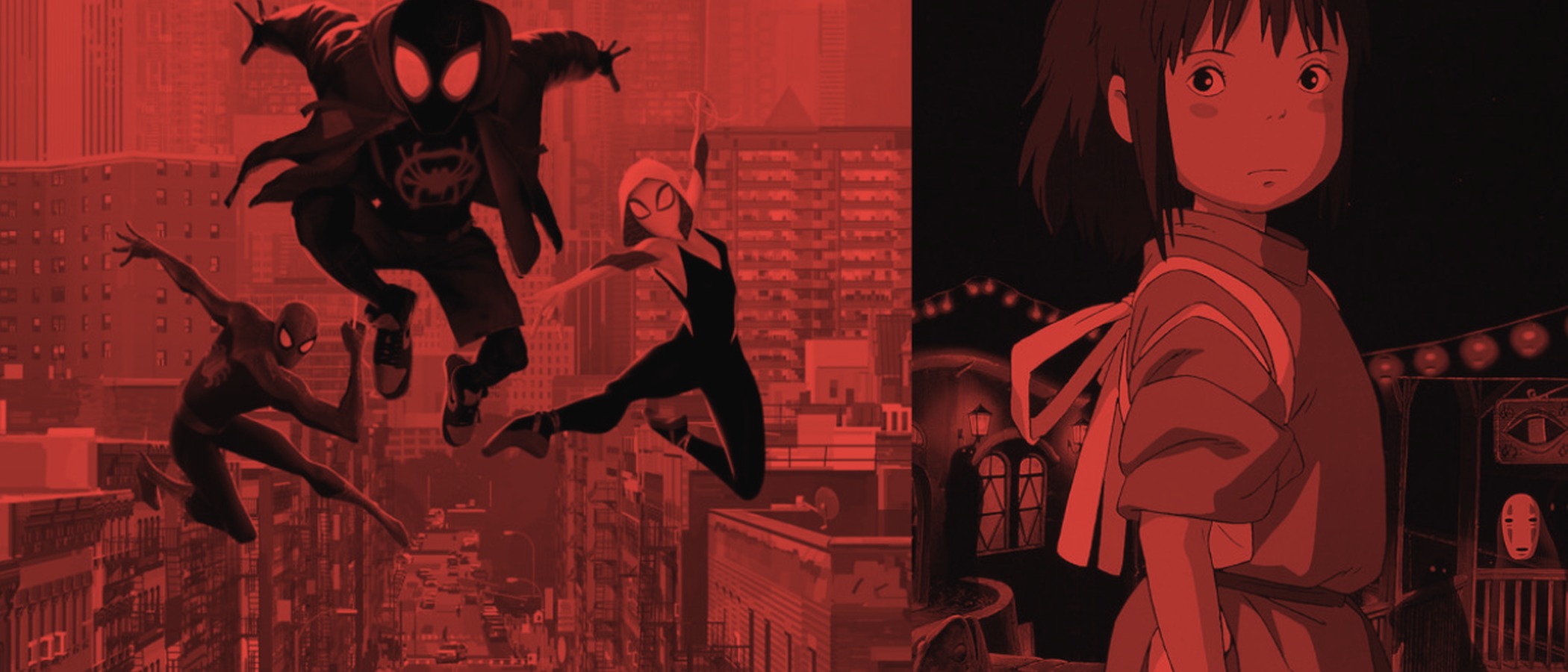
The numbers prove it. Since Best Animated Feature was introduced, only three animated films have been nominated for Best Picture: Up (2009), Toy Story 3 (2010), and Beauty and the Beast's 1991 nomination predated the category. In the two decades since, precisely zero animated films have won Best Picture. Not Wall-E. Not Inside Out. Not Spider-Man: Into the Spider-Verse. Not Spirited Away. Not a single one.
Are we really saying that in twenty-plus years, no animated film has been the best film of its year? Really?
The "It's for Kids" Fallacy
The root of the problem is a bias so deeply embedded that most people don't even recognise it: the assumption that animation is a children's medium. It's not a genre - it's a technique. Saying "animated films are for kids" is like saying "films shot on digital are for YouTube." The medium doesn't determine the audience; the content does.
Grave of the Fireflies (1988) is one of the most devastating anti-war films ever made. It's animated. Waltz with Bashir (2008) is a documentary about the psychological trauma of the Lebanon War. It's animated. Persepolis (2007) is a political memoir about growing up during the Iranian Revolution. It's animated. Anomalisa (2015) is a Charlie Kaufman film about loneliness, infidelity, and the monotony of existence. It's animated, and it's decidedly not for children.
Even the films that are ostensibly for children operate on levels of emotional sophistication that most live-action films can't touch. Inside Out is a film about the neurological function of sadness in emotional development. It's more psychologically rigorous than most dramas. Coco is a meditation on death, memory, and family obligation that had entire cinemas sobbing. Wall-E's first forty minutes - virtually dialogue-free - are among the most visually accomplished sequences in modern cinema.
The Academy voters who dismiss these films as "cartoons" are revealing their own limitations, not the medium's.
The Miyazaki Standard
Hayao Miyazaki and Studio Ghibli have been producing masterpieces for four decades. Spirited Away (2001), Princess Mononoke (1997), My Neighbour Totoro (1988), The Wind Rises (2013) - these are not children's entertainment. They're profound, complex, visually staggering works of art that deal with environmentalism, mortality, war, and the impossibility of innocence in an industrialised world.
Spirited Away won Best Animated Feature in 2003 - the first and, for a long time, only non-English-language film to do so. It was not nominated for Best Picture. In any rational universe, Spirited Away would have been a serious contender for the top prize. It's better than most Best Picture winners of the 2000s, and it's not even close.
Miyazaki reportedly didn't attend the ceremony. He was opposed to the Iraq War and didn't want to visit a country that was conducting it. This is the level of artist we're talking about - someone who turns down Hollywood's biggest night on moral principle - and the Academy couldn't be bothered to nominate his masterpiece for Best Picture because it was a "cartoon."
Spider-Verse Changed Everything (And Nothing)
Spider-Man: Into the Spider-Verse (2018) is, by any reasonable measure, one of the best superhero films ever made. It's visually revolutionary - every frame is a work of art, blending comic book aesthetics with cutting-edge animation in ways that had never been attempted. It's narratively inventive, emotionally resonant, and funnier than most live-action comedies.
It won Best Animated Feature. It was not nominated for Best Picture. The Best Picture winner that year was Green Book, a film about racism that's about as cinematically adventurous as a Travelodge breakfast buffet.
Into the Spider-Verse is more visually innovative than every Best Picture nominee that year combined. It pushed the boundaries of what cinema can look like more than any live-action film of the decade. And it was consigned to "the animation category" because... it was animated. That's it. That's the entire reason.
The sequel, Across the Spider-Verse (2023), was even more ambitious and even more critically acclaimed. Same result: wins Best Animated Feature, ignored for Best Picture. The pattern is immovable.
The Pixar Problem
Pixar has produced more consistently excellent films than any studio in Hollywood history. Their worst film is better than most studios' best. And yet, across roughly thirty feature films, they've received exactly two Best Picture nominations. Two.
Consider what Pixar has achieved: Toy Story (the first fully computer-animated feature), Finding Nemo (the highest-grossing animated film of its era), The Incredibles (a better superhero film than most Marvel entries), Ratatouille (a film about art, criticism, and the courage to create), Wall-E (an environmental elegy disguised as a robot love story), Inside Out (a film that genuinely changed how people talk about emotions), Coco (a cultural celebration of extraordinary warmth and specificity).
Any of these could have won Best Picture in their respective years. None of them were seriously considered. The Academy nods politely at Pixar, gives them their animation prize, and moves on to reward whatever prestige drama features a famous actor gaining or losing weight.
What Would Have to Change
For animated films to have a genuine shot at Best Picture, two things would need to happen:
First, the voting demographics would need to shift. Academy membership has historically skewed older and more traditional, and older voters are the ones most likely to view animation as inherently lesser. Younger members - who grew up with Pixar, Ghibli, and Spider-Verse - are more likely to evaluate animated films on their merits. The Academy has made efforts to diversify its membership, but the bias runs deep.
Second, the Best Animated Feature category would need to be abolished. This is controversial, but hear it out: as long as animation has a dedicated category, voters will use it as an excuse not to consider animated films for the top prize. "It already won its Oscar" becomes the justification for exclusion. Remove the category, force animated films to compete on equal terms, and the conversation changes immediately.
Will this happen? Almost certainly not. The Best Animated Feature category generates its own press coverage, its own campaigns, and its own revenue for the ceremony. It exists because it's useful, not because it's fair. And in Hollywood, useful always beats fair.
The Artistic Case
Animation is, frame for frame, the most labour-intensive form of filmmaking. A single frame of Spider-Verse required more artistic decisions than most live-action scenes. Every expression is designed. Every background is painted. Every movement is choreographed by hand, pixel by pixel, frame by frame. The idea that this is somehow less cinematic than pointing a camera at actors on a set is preposterous.
Live-action filmmaking captures reality and shapes it. Animation creates reality from nothing. Every element - every shadow, every colour, every texture - is a conscious artistic choice. There is no happy accident of natural light, no serendipitous background detail. Everything on screen is there because someone put it there. That's not a limitation. It's a higher standard of intentionality than live-action can typically achieve.
The greatest animated films are among the greatest films, full stop. They deserve to be recognised as such. Not in a separate category, not with a patronising "for a cartoon, it's pretty good" qualifier, but alongside every other film, judged on the same criteria: storytelling, craft, emotional impact, and artistic ambition.
Until the Academy figures that out, the Oscars will continue to be incomplete. The best films of many years won't have Best Picture nominations. And the statue will keep going to whichever live-action drama made the most voters feel comfortable about themselves.
Which is, when you think about it, the least animated thing in cinema.
Related Articles
- Oscar Snubs That Still Piss Us Off - The losses and omissions that haunt the Academy
- Why Practical Effects Will Always Beat CGI - The case for handmade filmmaking
- Films That Were Too Ahead of Their Time - Movies the world wasn't ready to appreciate
- Comfort Rewatches - The films we return to when we need them most
- Movie Scores That Outgrew Their Films - When the music transcends the movie