Near the top of Mount Doom, Frodo cannot walk any further and Sam says the line: I can't carry it for you, but I can carry you. Then he picks him up. Nobody in The Return of the King says the word love out loud, and nobody needs to, because the film has just spent nine hours showing you what it looks like when it is not said.
That is the trick of the screen bromance and it is why I trust it more than most screen romances. The romance has to announce itself. The friendship has to be proved, usually by someone doing something stupid and expensive for someone else and then insulting them about it afterwards. Here are the ten pairs that prove it best, from two hobbits to two hitmen arguing about foot massages.
Frodo and Sam - The Lord of the Rings (2001-2003)
Let's get this one out of the way first because it's the correct answer and everyone knows it. Sam carrying Frodo up Mount Doom - "I can't carry it for you, but I can carry you!" - is the single most emotionally devastating expression of friendship in cinema history. Full stop. End of discussion.
What makes the Frodo-Sam dynamic so powerful is that it's entirely unequal. Sam gets nothing from this friendship except suffering, danger, and the privilege of watching his best friend slowly lose his mind. He follows Frodo into certain death not because he's brave (he's terrified) or because he's obligated (he could leave at any point) but because he simply cannot conceive of a world where he lets his friend face this alone.
If you can watch "My friends, you bow to no one" without getting misty-eyed, you are clinically dead inside.
Woody and Buzz - Toy Story (1995-2019)
They start as rivals, become reluctant allies, and end as the kind of friends who'd cross an entire country to save each other. The Woody-Buzz dynamic across four films charts the entire emotional arc of a great friendship: jealousy, acceptance, loyalty, sacrifice, and the devastating moment when you realise your paths are diverging and you have to let go.
Toy Story 3's incinerator scene - where the toys hold hands and accept death together - is the most gut-wrenching moment Pixar has ever produced. And it works because we've spent three films watching these characters build something real. When Woody says "so long, partner," every adult in the cinema immediately starts ugly-crying. Animated toys should not have this power over grown humans. And yet.
Butch Cassidy and the Sundance Kid (1969)
The original movie bromance. Paul Newman and Robert Redford had such extraordinary chemistry that the actual love interest (Katharine Ross) feels like a third wheel in her own film. Butch's charm and Sundance's competence create a dynamic so effortlessly appealing that every buddy movie since has been trying to replicate it.
The final freeze-frame - two friends running into certain death together, choosing loyalty over survival - established the template for bromantic sacrifice that cinema has been mining ever since. They could have split up. They could have surrendered. Instead, they chose each other, and that choice elevated a Western into myth.
Shaun and Ed - Shaun of the Dead (2004)
Simon Pegg and Nick Frost's friendship is the beating heart of the Cornetto Trilogy, but it's purest in Shaun of the Dead. Ed is, objectively, a terrible friend - lazy, irresponsible, a liability in a zombie apocalypse. But Shaun's loyalty to him is unshakeable because friendship isn't about utility, it's about history. Ed is the mate from school who never grew up, and Shaun loves him anyway.
Ed's sacrifice - staying behind to give Shaun time to escape - is played for both comedy and genuine tragedy. And the final scene - Ed as a zombie, still playing video games in the shed - is simultaneously the funniest and most touching image in the entire film. Some friendships survive even death. And zombification, apparently.
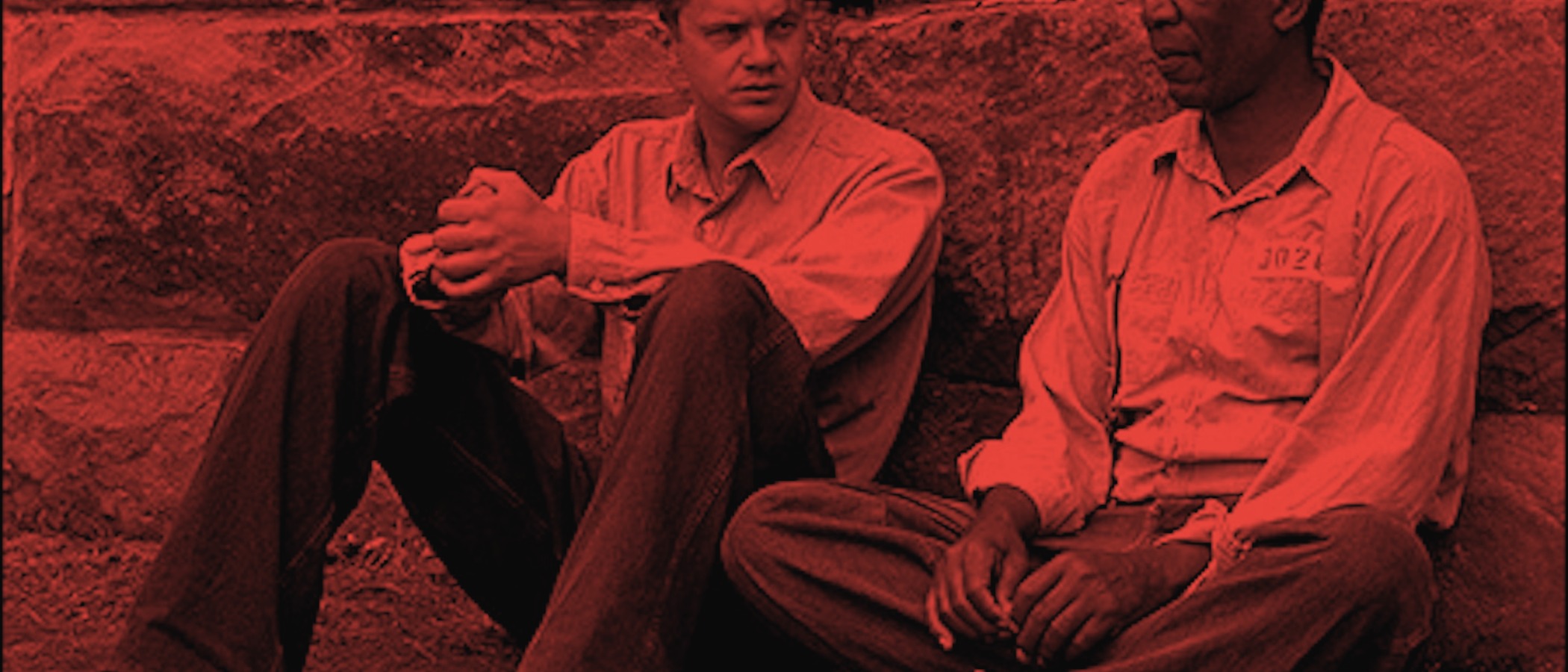
Andy Dufresne and Red - The Shawshank Redemption (1994)
A friendship built in prison, sustained by hope, and fulfilled on a beach in Mexico. Tim Robbins and Morgan Freeman's chemistry is so warm, so genuine, and so completely devoid of Hollywood artifice that their relationship feels documentary-real.
Red's narration gives us access to Andy as an enigma - the quiet man with a plan that nobody else can see. When the plan is revealed, the film soars. But it's the final scene - two old friends reunited on a sunlit beach - that provides the emotional payoff. It's the most optimistic ending in cinema, earned through two hours of suffering, patience, and the unspoken understanding between two men that hope isn't naive; it's essential.
Riggs and Murtaugh - Lethal Weapon (1987)
The template for every mismatched buddy cop dynamic that followed. Mel Gibson's suicidal loose cannon and Danny Glover's exhausted family man shouldn't work together, and the film knows it. "I'm too old for this shit" isn't just a catchphrase - it's the thesis statement of a film about two men who make each other better despite having nothing in common.
What elevates Lethal Weapon beyond its imitators is that the friendship has stakes. Riggs is genuinely suicidal, and Murtaugh's family becomes the anchor that gives him a reason to live. By the end, Riggs isn't just a better cop - he's a less broken human. The Christmas dinner invitation is the film's real climax, not the gunfight.
Will and Marcus - Bad Boys (1995)
Will Smith and Martin Lawrence bickering their way through explosive set pieces defined 90s action comedy. The Bad Boys franchise runs on the chemistry between Smith's smooth playboy and Lawrence's anxious family man, and the miracle is that it never gets old. Their arguments feel improvised, their insults feel real, and their loyalty to each other is absolute.
The "who's driving?" argument is funnier than most entire comedies. And when the franchise returned in 2020 with Bad Boys for Life, the emotional depth surprised everyone - suddenly these two idiots had three decades of friendship to draw on, and the film was better for it.
Doc and Marty - Back to the Future (1985)
The single most unlikely friendship in cinema: a teenage slacker and a disgraced nuclear physicist. Why are they friends? Nobody knows. The film never explains it, and it doesn't matter because Christopher Lloyd and Michael J. Fox's chemistry is so immediate and so joyful that you accept it completely.
"If you put your mind to it, you can accomplish anything" is Doc's gift to Marty - the faith of an older man in a younger one's potential. And Marty's willingness to risk his own existence to save Doc is the reciprocal gift. It's intergenerational friendship at its most pure: the old mentor who still believes in wonder, and the young friend who reminds him why.
Jules and Vincent - Pulp Fiction (1994)
Two hitmen discussing cheeseburgers on the way to murder someone. Tarantino understood that what makes friendship cinematic isn't grand gestures - it's the mundane conversations you have with someone you're comfortable with. Jules and Vincent talk about foot massages, television pilots, and the metric system, and these conversations are more revealing than any dramatic monologue.
The tragedy is that their friendship ends abruptly and senselessly - Vincent dies on a toilet, killed by the boxer he was supposed to be watching. Tarantino's non-linear structure means we see them alive after Vincent's death, creating a strange, melancholy loop where the friendship continues even though we know it's already over.
Honourable Mentions
Good Will Hunting's Will and Chuckie - "I hope you're not there" is the most selfless line in bromance history. Step Brothers' Brennan and Dale - "Did we just become best friends?" Rush's Hunt and Lauda - rivalry as the highest form of respect. The Nice Guys' Holland March and Jackson Healy - underrated, underseen, utterly brilliant.
Why Bromances Matter
Male friendship on screen matters because male friendship off screen is in crisis. Men are lonelier than ever, less likely to have close friends, and culturally discouraged from expressing emotional vulnerability. The movie bromance, for all its comedy and hyperbole, models something vital: that it's okay to love your mates, to need them, to tell them they matter.
Cinema's greatest bromances work because they're about something real - the terrifying, wonderful, irreplaceable experience of finding someone who gets you. And if that message comes wrapped in zombie attacks, time travel, and competitive insults, well, that's just good packaging.
Test Your Film Knowledge
- Movie Quotes - Test your knowledge of iconic bromance lines
- Emoji Plot - Decode movie plots told in emojis
- Six Degrees Sprint - Connect bromance stars through their films
Related Articles
- Comfort Rewatches - Bromance films are peak comfort viewing
- Movie Deaths That Hurt Most - When bromances end in tragedy
- Top 10 Comedy Movies of All Time - Many of these are bromance classics
- One-Scene Wonders - The best friends who stole the show