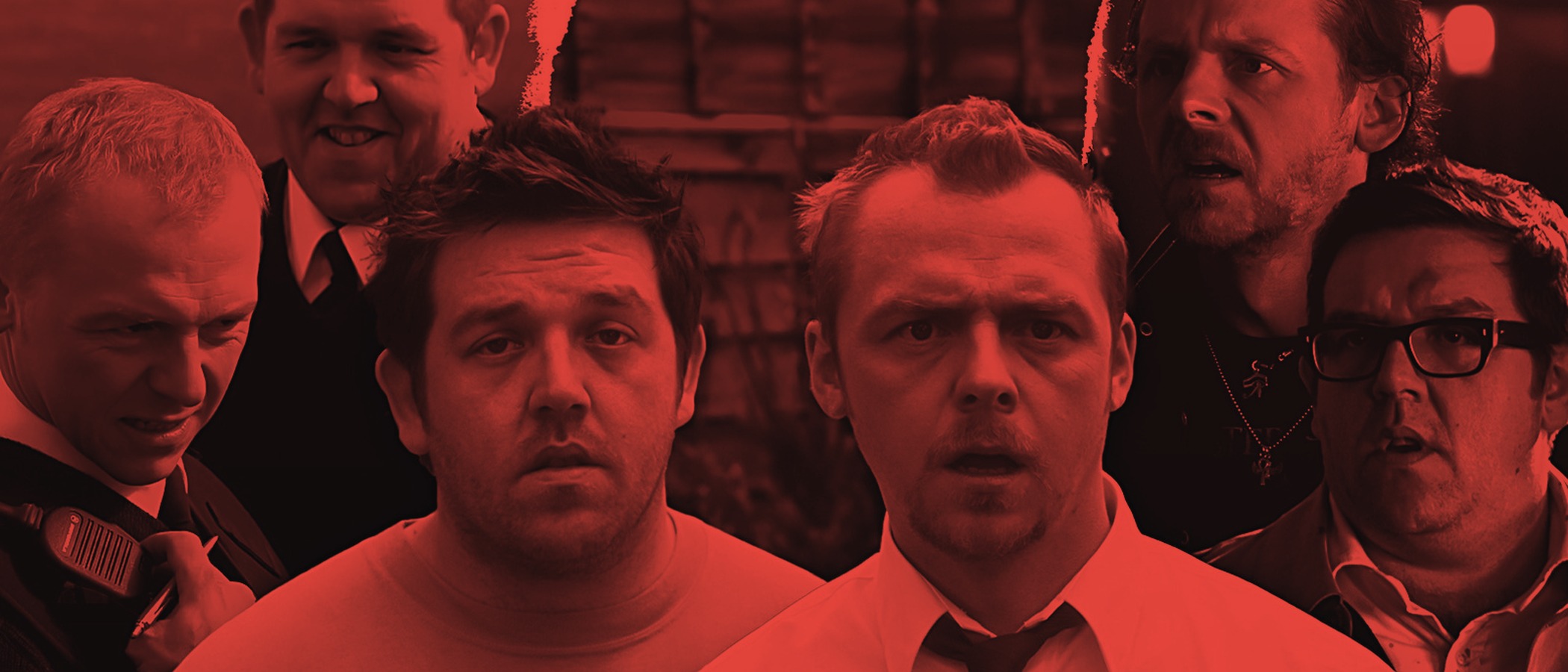
Between 2004 and 2013, Edgar Wright, Simon Pegg, and Nick Frost made three films that collectively represent the best British comedy of the 21st century. Linked by a shared Cornetto ice cream gag, a visual style unlike anything else in British cinema, and the central friendship between Pegg and Frost, the trilogy proved that you could make films that were simultaneously hilarious, technically brilliant, and emotionally genuine.
Each film takes a genre, filters it through the lens of ordinary British life, and finds something true in the collision. The joke isn't that genres are silly. The joke is that British life already contains everything those genres are about - we just don't notice because we're too busy getting a round in.
Shaun of the Dead (2004): Love in the Time of Zombies
The premise is deceptively simple: Shaun (Pegg) is a 29-year-old man-child working in an electronics shop, recently dumped by his girlfriend Liz (Kate Ashfield), whose plan for surviving a zombie apocalypse is to go to the Winchester pub and wait for it all to blow over.
What makes Shaun of the Dead work isn't the zombie stuff - it's the human stuff. Shaun's relationship with Liz is genuinely recognisable. His frustration with his stepfather Philip (Bill Nighy) rings true. His co-dependent friendship with Ed (Frost) is the kind of enabling dynamic that thousands of British men are trapped in right now. Wright uses zombies as a metaphor for the sleepwalking existence that Shaun needs to wake up from, and the metaphor works because it's never laboured.
The technical craft is staggering. Wright's editing - the quick-cut montages of Shaun's daily routine, the synchronized pub fight set to Queen's "Don't Stop Me Now," the visual callbacks that reward repeat viewings - established a filmmaking vocabulary that every comedy director has been trying to copy since. The fence-jumping gag. The cornershop tracking shot. The way Shaun walks past zombies without noticing because they look exactly like normal commuters. Every frame contains a joke, and most of them also advance the plot.
But the film earns its emotional moments too. Philip's death scene is genuinely moving. The moment Shaun has to shoot his mother is devastating. And Ed's sacrifice in the cellar - the friend who'll never grow up choosing to stay behind - is played for real tears, not laughs. Shaun of the Dead proved that comedy and horror share the same DNA, and that a British sitcom about a useless bloke could be as emotionally complex as any drama. We've included it on our best British horror films list too, because it earns its place there.
Hot Fuzz (2007): The Dark Heart of the English Village
If Shaun was about London mediocrity, Hot Fuzz is about provincial perfection taken to homicidal extremes. Simon Pegg plays Nicholas Angel, London's best police officer, who's transferred to the idyllic village of Sandford because he's making everyone else look bad. Nick Frost is Danny Butterman, the local chief inspector's son, who's seen every action film ever made and desperately wants his life to be one.
The genius of Hot Fuzz is that it's three films in one. For the first act, it's a fish-out-of-water comedy about a competent man in an incompetent system. For the second, it's a genuine mystery - the "accidents" piling up in Sandford are suspicious, and Wright plays the investigation straight enough that you're actually trying to solve it. For the third act, it becomes the Point Break/Bad Boys II action extravaganza that Danny always wanted, complete with the most absurdly entertaining village shootout in cinema history.
The supporting cast is ridiculous in the best way. Timothy Dalton as Simon Skinner, the supermarket owner whose every line sounds like a confession, is the film's MVP. Jim Broadbent as the avuncular chief inspector. Paddy Considine and Rafe Spall as the detective "Andys." Billie Whitelaw, Edward Woodward, and the rest of the Neighbourhood Watch Alliance - all perfectly cast, all getting the tone exactly right.
Wright's love of action cinema is genuine, and it shows. The quick-cut editing, the dramatic zooms, the over-the-top sound design - these aren't parody. They're tribute. When Angel finally lets loose with a cache of confiscated weapons, the action is filmed with the same craft and energy as the Hollywood films it references. The joke isn't that action films are stupid. The joke is that this kind of excitement was lurking in Middle England all along.
The World's End (2013): The One Nobody Expected
The World's End is the trilogy's most ambitious and most divisive entry. Simon Pegg plays Gary King, a 40-something alcoholic who convinces his four estranged childhood friends to return to their hometown of Newton Haven and complete the "Golden Mile" - a twelve-pub crawl they attempted and failed when they were eighteen. The catch is that the town has been taken over by alien-controlled robot duplicates.
Here's the thing about The World's End that people miss: Gary King is the trilogy's most complex character, and Pegg's performance is its best. Gary isn't loveable. He's a manipulative, selfish addict who peaked at 18 and has spent the subsequent decades refusing to accept that life moved on without him. He's funny, but he's also deeply sad, and Pegg plays the darkness with a commitment that surprised everyone who expected another Shaun.
Nick Frost, crucially, plays the serious one this time. Andy Knightley is the responsible friend who stopped drinking, got in shape, and moved on with his life. Reversing the Pegg-Frost dynamic was a bold choice, and it pays off in the film's emotional scenes - the bathroom confrontation between Gary and Andy, where decades of resentment finally surface, is the trilogy's finest dramatic moment.
The alien invasion plot is deliberately absurd, but it serves a thematic purpose. Newton Haven has been "improved" by aliens who've replaced imperfection with bland conformity - the pubs are all identical, the people are all pleasant, individuality has been erased in favour of efficiency. Gary's refusal to accept this isn't heroic. It's pathological. He'd literally rather the world end than accept that things change. The film's title is a description of his psychology, not just the plot.
The action sequences are Wright's best - the bathroom fight scene with the "blanks" is choreographed with a fluidity that rivals genuine martial arts cinema. Martin Freeman, Paddy Considine, and Eddie Marsan round out the friend group, and each gets their moment. The film's climax, where Gary argues with an alien intelligence and essentially talks the universe into giving up on humanity, is both hilarious and weirdly profound.
If these films inspire your walls as much as your watchlist, check out our Minimal Film Posters pack - 27 print-ready designs from £2.99.
What Makes the Trilogy Work
Three things elevate these films above every other comedy series:
Visual storytelling. Wright trusts the audience to keep up. Background gags, visual foreshadowing, editing rhythms that create jokes through juxtaposition rather than dialogue - these films reward the tenth viewing as much as the first. The "fence" gag in Hot Fuzz. The colour coding in The World's End. The shot-for-shot recreation of Shaun's morning routine. Wright's brain works at a speed most directors can't match.
Genuine emotion. Every film has a moment that stops the comedy dead and makes you feel something real. Philip's death. Danny's betrayal. Gary's attempted suicide. These moments work because Wright and Pegg's scripts have built characters you actually care about. The comedy earns the drama, and the drama makes the comedy matter.
Britishness. These films are unapologetically, uncompromisingly British. The settings, the dialogue, the social dynamics, the humour - none of it is translated or softened for international audiences. And international audiences loved them anyway, because specificity is universal. A Winchester pub in North London is as vivid a location as the Mos Eisley Cantina, and considerably more believable.
The Cornetto Trilogy is complete, and Wright has said there won't be a fourth. He's right not to push it. Three perfect films is enough. Three perfect films is a miracle.