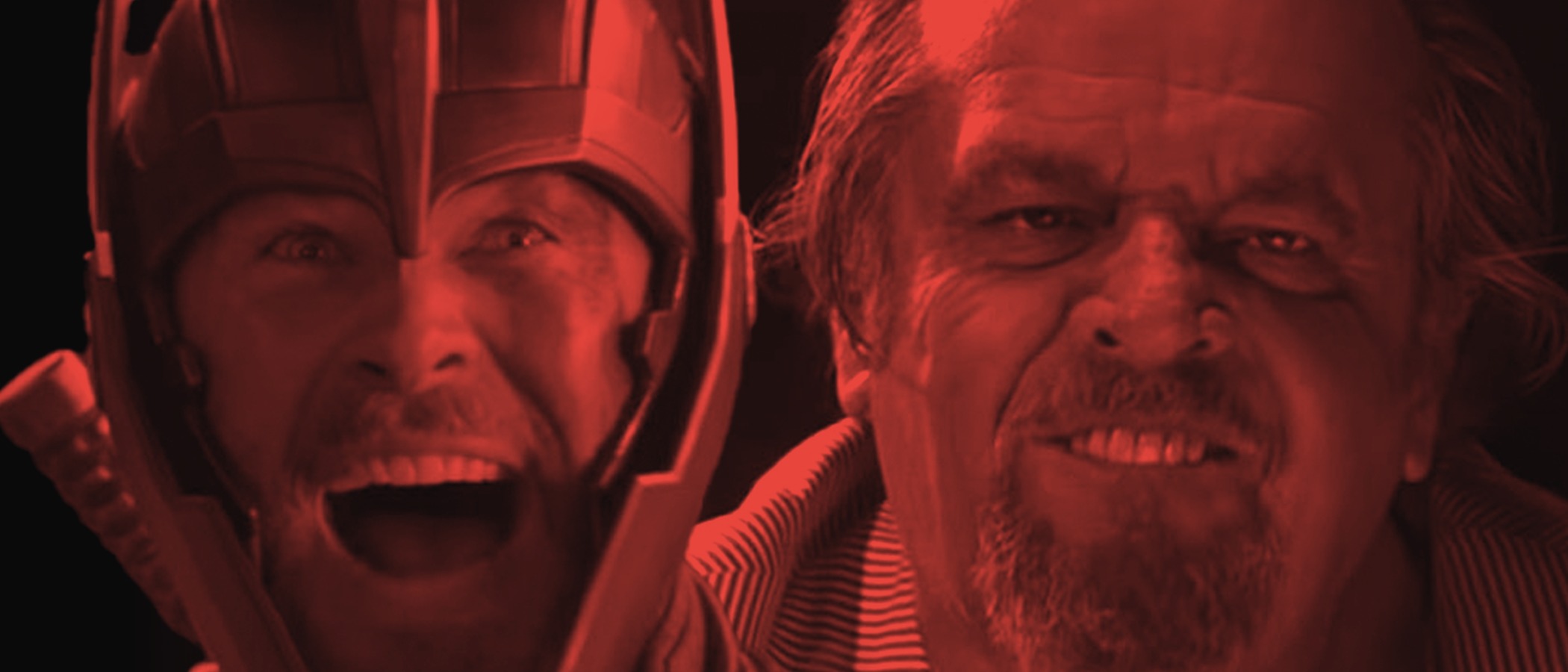
There's a particular kind of magic that happens when an actor goes off-script and the director has the sense to keep the camera rolling. It's the collision of preparation and spontaneity - an actor so deep inside a character that they produce something no writer could have anticipated. The best improvised moments in cinema don't feel improvised at all. They feel inevitable, like they were always supposed to be there.
These are the ones that made the final cut, elevated the films they appeared in, and in some cases became the most quoted lines in movie history. All because someone forgot their lines, got bored with the script, or was simply too brilliant to contain.
"You Talkin' to Me?" - Taxi Driver (1976)
The most famous improvisation in cinema wasn't written by Paul Schrader. It was Robert De Niro, standing in front of a mirror, riffing on the concept of Travis Bickle practising for confrontation. The script simply said: "Travis speaks to himself in the mirror." That's it. De Niro turned that stage direction into one of the most iconic moments in American cinema.
"You talkin' to me? You talkin' to me? Then who the hell else are you talkin' to?"
What makes it work isn't the words - it's the escalation. De Niro starts almost playful, testing the phrase, feeling it out. Then it builds. The repetition becomes more aggressive, more paranoid, until you're watching a man rehearse violence in real time. It's terrifying because it feels real, and it feels real because it essentially was - De Niro wasn't performing a written scene, he was channelling a character's psychosis in the moment.
Scorsese kept it because he recognised he was watching something he couldn't have scripted if he'd tried for a hundred years.
"Here's Johnny!" - The Shining (1980)
The script for The Shining had Jack Nicholson axe through the bathroom door. It did not have him quoting Ed McMahon's Tonight Show catchphrase while doing it. That was pure Nicholson - a flash of deranged showmanship in the middle of Kubrick's meticulously controlled nightmare.
Kubrick, famously, hated improvisation. He shot everything dozens of times until the performances matched his precise internal vision. The fact that he kept "Here's Johnny!" tells you everything about how good it was. It's the perfect detail: Jack Torrance isn't just a man losing his mind, he's a failed entertainer, and even in his most violent moment, he's performing. The line adds a layer of pathetic showbiz desperation to the horror that Kubrick couldn't have planned.
Nicholson apparently did it on one take. Even Kubrick knew when to stop shooting.
The Chest-Burster Reactions - Alien (1979)
This one's less about dialogue and more about authentic terror. Ridley Scott told the cast that something would happen during the dinner scene but didn't tell them what. When the xenomorph burst out of John Hurt's chest, spraying blood and viscera across the table, the reactions of Veronica Cartwright, Yaphet Kotto, and the rest were genuine shock and horror.
Cartwright was hit in the face with a spray of fake blood she wasn't expecting. Her scream - the one that makes that scene so unbearable - is real. She was terrified. The entire table was terrified. Scott filmed their authentic responses and used them, because no amount of acting direction could have produced reactions that raw.
It's a manipulation technique more than an improvisation, but the result is the same: a scene that feels utterly real because, in the moment of filming, it was.
"I'm Walkin' Here!" - Midnight Cowboy (1969)
The legend goes like this: during filming in New York, a real taxi nearly hit Dustin Hoffman while crossing the street, and his furious reaction - "I'm walkin' here! I'm walkin' here!" - was a genuine response that director John Schlesinger kept in the film.
The truth is slightly more complicated. The taxi was real (they were filming without permits and the driver didn't know), but Hoffman has admitted he was aware enough to stay in character rather than break. So it's improvisation in the truest sense: an actor responding to an unplanned stimulus through the lens of his character. Ratso Rizzo wouldn't flinch at a taxi - he'd rage at it. And Hoffman channelled that rage instinctively.
It's become shorthand for New York attitude, which is fitting, because it was born from actual New York chaos.
The Entirety of This Is Spinal Tap (1984)
Rob Reiner's This Is Spinal Tap barely had a script. The "screenplay" was more of a structural outline - here's the scene, here's what needs to happen, now go. Christopher Guest, Michael McKean, and Harry Shearer improvised virtually every line of dialogue in the film, creating characters so convincingly stupid that real musicians thought Spinal Tap was an actual band.
"But this one goes to eleven" was improvised. The Stonehenge mix-up was improvised. The bread getting stuck in the pod was improvised. Every perfectly timed piece of rock-star idiocy was invented on the spot by three genuinely brilliant comedians who understood that the funniest improvisation comes from complete commitment to characters who are absolutely, catastrophically wrong about everything.
The film essentially invented the mockumentary format and proved that sometimes the best script is no script at all.
"Funny How?" - Goodfellas (1990)
The "funny how" scene between Joe Pesci and Ray Liotta was based on something that actually happened to Pesci when he was working as a waiter. He told a real mobster he was "funny," and the room went deathly quiet. Pesci brought the story to Scorsese, who told him to work it into the restaurant scene - but didn't tell Liotta or the other actors what was coming.
So when Pesci turns on a dime from jovial storyteller to "Funny how? Like I'm a clown? I amuse you?" - the nervous laughter from the cast is real. They genuinely didn't know if Pesci was joking or if the scene had gone sideways. That uncertainty - is this still acting? - is what makes it one of the most tense scenes in cinema. You can feel the table trying to figure out whether Tommy is about to kill someone.
The answer, of course, is that Tommy is always about to kill someone. That's the whole point.
Robin Williams in Everything
Robin Williams was essentially incapable of sticking to a script. Directors learned to keep the camera rolling because the best stuff always came between takes or during riffs on the written dialogue.
In Good Will Hunting, the "farting wife" story that makes Matt Damon genuinely crack up was improvised. In Aladdin, Williams recorded so much improvised material that the animators had sixteen hours of audio to work with. In Good Morning, Vietnam, the radio broadcast scenes were almost entirely unscripted - Barry Levinson just turned Williams loose and captured the result.
Mrs. Doubtfire is essentially a Robin Williams improvisation reel held together by a plot. The social worker dinner scene? Half improvised. The cooking disaster? Half improvised. The face falling into the cake? Planned, but Williams' reaction to it was entirely his own.
Williams' improvisations worked because they weren't showing off - they were channelled through character. His Genie isn't Robin Williams being Robin Williams; it's the Genie being the Genie, who happens to have Robin Williams' brain. That distinction matters.
"I Know" - The Empire Strikes Back (1980)
The script had Han Solo respond to Leia's "I love you" with "I love you too." Harrison Ford thought it was wrong for the character and, after dozens of takes that weren't working, tried "I know" instead. Irvin Kershner, the director, loved it. George Lucas hated it. Kershner kept it anyway.
It's perfect because it tells you everything about Han Solo in two syllables. He's arrogant, self-aware, emotionally unavailable, and - crucially - terrified. He's about to be frozen in carbonite. "I love you too" would be surrender. "I know" is armour. It's the most Han Solo thing Han Solo could possibly say, and no writer would have dared put it on the page because it looks wrong on paper. It only works when Ford says it, in that moment, with that expression.
Ford has been dining out on those two words for forty-five years, and honestly, fair play.
Bill Murray in Literally Everything
Bill Murray operates on a different plane of existence from most actors. In Ghostbusters, most of his best lines were improvised - "Back off, man, I'm a scientist" was not in the script. In Caddyshack, the entire Carl Spackler character was built from improvisation; the "Cinderella story" golf monologue was Murray alone on a set, talking to himself.
In Lost in Translation, Sofia Coppola gave Murray enormous freedom to simply be in scenes. The whispered ending - which we can't hear - may or may not have been improvised; Coppola won't say, and Murray won't say, and the ambiguity is part of the magic.
Murray and Williams represent opposite poles of improvisation: Williams was volcanic, explosive, overwhelming. Murray is tectonic - slow, subtle, devastating. Both are impossible to script.
The Common Thread
Every great film improvisation shares one quality: it serves the character, not the actor's ego. De Niro's mirror scene works because it's Travis Bickle, not Robert De Niro, who's performing. Ford's "I know" works because it's Han Solo, not Harrison Ford, who's being smug. The actors who improvise badly are the ones who break character to be clever. The ones who improvise brilliantly are the ones who go deeper into character than the script could take them.
The best scripts leave room for this. The best directors recognise it when it happens. And the best actors know the difference between going off-script and going off-character.
One is chaos. The other is art.
Related Articles
- Method Actors Who Went Too Far - When commitment to the role becomes actual insanity
- Behind the Scenes Disasters - Production chaos that somehow produced great cinema
- One-Scene Wonders - Supporting actors who stole entire films
- Actors Who Only Play Themselves - When the persona becomes the performance
- Top 10 Comedy Movies of All Time - The funniest films ever made