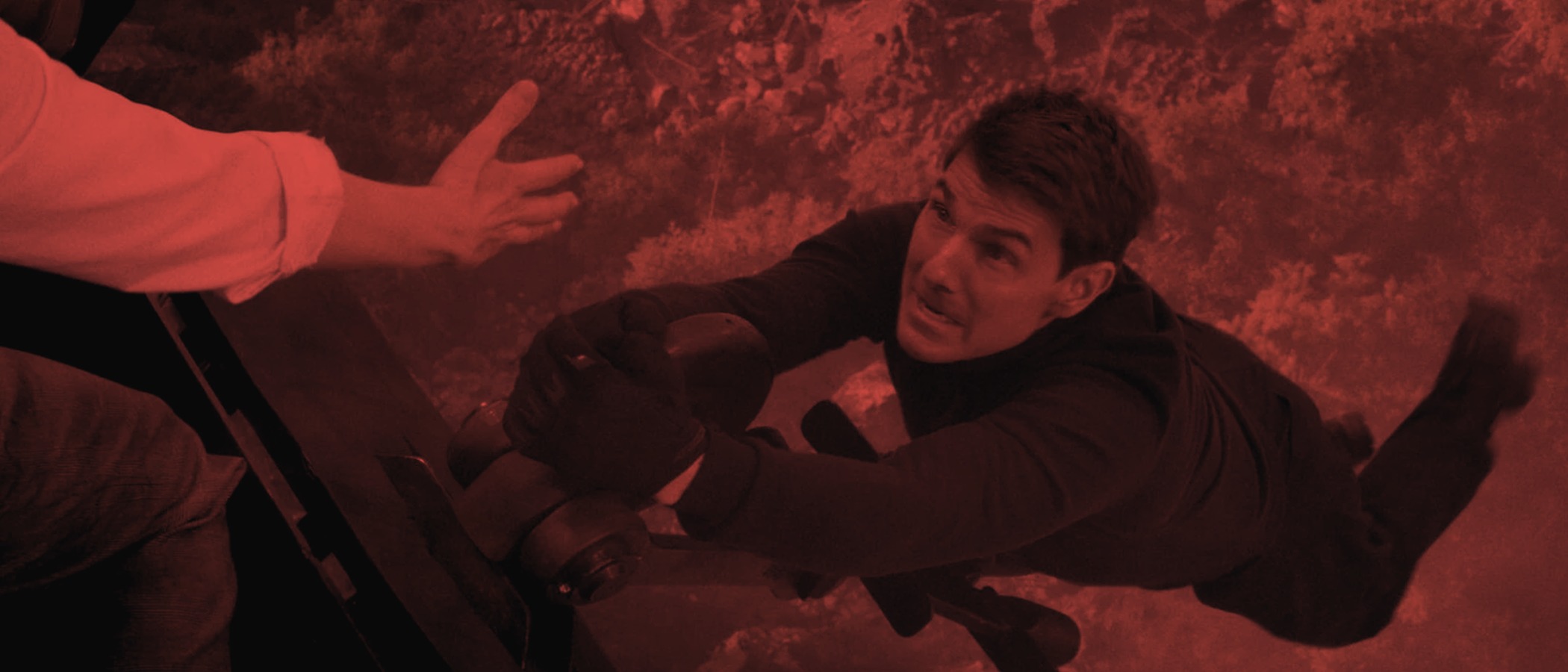
Somewhere in Hollywood, there exists a species of actor who looks at a stunt coordinator's carefully designed, safely executable action sequence and says, "Nah, I'll do it myself." Some of them are adrenaline junkies. Some have a genuine artistic argument for physical performance continuity. And some are just slightly mental. All of them give their insurance companies heart palpitations.
Here's the thing about doing your own stunts: when it works, it's extraordinary. The audience can tell when it's really the actor in frame, and the visceral impact is undeniable. When it doesn't work, production shuts down for months while bones heal. The line between heroism and foolishness is measured in successful take ratios.
Tom Cruise - The Patron Saint of Self-Endangerment
We might as well start with the undisputed king. Tom Cruise doesn't just do his own stunts - he invents new ways to risk his life that didn't previously exist. Hanging off the side of an Airbus A400M during takeoff for Mission: Impossible - Rogue Nation. Doing a HALO jump from 25,000 feet for Fallout. Flying an actual fighter jet for Top Gun: Maverick. The man is either the most dedicated actor in cinema history or someone who has fundamentally misunderstood the concept of a stunt double.
The most telling incident was during Mission: Impossible - Fallout when Cruise broke his ankle doing a building-to-building jump. He hit the edge of the building wrong, fractured the ankle, and - here's the Cruise part - kept running on it to complete the take. The footage of the break is in the final film. He was then off production for six weeks while it healed, costing the studio millions in delays. His commitment is both inspiring and financially irresponsible.
But here's the thing nobody wants to admit: Cruise's stunt work genuinely makes his films better. The reason the Mission: Impossible franchise has gotten better with age - the opposite of most action series - is that audiences know it's really him. That knowledge creates a tension that no CGI can replicate. When you watch Tom Cruise dangle off a cliff, your brain knows that a 60-year-old man is actually dangling off a cliff, and that primal awareness makes every second electric.
Jackie Chan - The Human Crash Test Dummy
Jackie Chan has broken virtually every bone in his body across a career spanning five decades. His injury list reads like a medical textbook: broken nose (multiple times), broken cheekbone, broken ankle, broken fingers (too many to count), cracked skull, damaged spine, dislocated shoulder, and a hole in his head from a stunt gone wrong on Armour of God (1986) that required emergency brain surgery.
The difference between Chan and Cruise is philosophy. Cruise does stunts to prove they can be done safely at scale. Chan's entire aesthetic is built on the audience seeing him get hurt. The outtakes that play during his end credits aren't blooper reels - they're injury compilations, showing the real price of what you just watched. Every successful stunt is surrounded by footage of failed attempts where Chan bounces off buildings, falls through glass, and lands on things that shouldn't support a human body.
Chan's approach is genuinely unique in cinema. He doesn't want to look cool - he wants to look like he's barely surviving, which he often literally is. The comedy comes from the gap between ambition and execution, and the physical toll is the authenticity tax. No one has ever made getting hurt look more entertaining, and no one has paid a higher physical price for their art.
Keanu Reeves - The Quiet Professional
Keanu doesn't do press tours about his stunt work. He doesn't film behind-the-scenes content showing how dangerous his takes are. He just quietly trains for months with world-class martial artists and firearms instructors, then performs sequences that would defeat most professional stunt performers.
For the John Wick franchise, Reeves trained extensively in judo, Brazilian jiu-jitsu, and three-gun competition shooting. The long-take fight sequences in those films work specifically because they can't cut away - it's genuinely Keanu performing the choreography, the throws, and the weapons handling in unbroken shots. Chad Stahelski (the director and former stunt coordinator) has said that Reeves performs approximately 90% of his own action work, which for the John Wick films represents an almost superhuman amount of physical performance.
The remarkable thing about Reeves is that he was in his mid-fifties when John Wick 4 was filmed. Most actors his age are doing legal thrillers and period dramas. He was falling down flights of stairs and being hit by cars. And he made it look easy, which is the greatest trick of all.
Harrison Ford - The Reluctant Daredevil
Ford didn't seek out stunt work - he just kept getting injured because he refused to let moments feel fake. During Raiders of the Lost Ark, he was dragged behind a real truck. During The Fugitive, he did the dam jump (from a partial height, but still). During Indiana Jones and the Dial of Destiny, he was doing horseback stunts in his late seventies.
The most famous Ford stunt injury occurred during Star Wars: The Force Awakens when a hydraulic door on the Millennium Falcon set malfunctioned and crushed his leg. He was 72 years old. The door broke his leg and nearly killed him - the production was fined for health and safety violations. Ford's response to the injury was essentially to shrug, heal, and come back.
What makes Ford's stunt work notable isn't the scale - it's the reluctance. He doesn't want to be an action hero. He wants to be a character actor who happens to appear in action films. But his physical commitment to those roles - his willingness to take real hits and real falls - is what made Indiana Jones and Han Solo feel real rather than plastic.
Viggo Mortensen - The Method Stuntman
Mortensen's approach to stunts in The Lord of the Rings trilogy was essentially: do everything for real, and if you get hurt, incorporate it. When he kicked the Uruk-hai helmet in The Two Towers and screamed, that scream was real - he'd broken two toes. Peter Jackson kept the take because the pain was genuine, and genuine pain is more convincing than performed pain.
Mortensen also insisted on using a real steel sword rather than a lighter aluminium prop. The result was more physically demanding but gave the combat a weight and authenticity that's visible on screen. When Aragorn's sword clashes with an opponent's weapon, you can hear real metal. When he's visibly exhausted during the battle scenes, he's actually exhausted.
The broken toes incident has become one of cinema's most famous stunt injuries, primarily because it's such a perfect encapsulation of the method approach: the best take is the one where the actor is in genuine pain, and the director is just lucky enough to be rolling. That's either brilliant filmmaking or workplace negligence, depending on your perspective.
Daniel Craig - Bond's Bruiser
Craig brought a brutality to James Bond that demanded physical authenticity. The opening parkour-inspired chase in Casino Royale (2006) featured Craig performing many of his own running, jumping, and fighting sequences - a significant departure from the more gentlemanly Bonds who preceded him.
Over five Bond films, Craig accumulated injuries including a sliced fingertip, torn shoulder muscles, damaged knee ligaments, a facial scar from a stunt gone wrong, and multiple sprains. He was so consistently injured that he once gave an interview where he said he'd "rather slash my wrists" than do another Bond film, which is the kind of honest exhaustion that PR teams have nightmares about.
But Craig's physicality transformed Bond. The franchise had become increasingly cartoonish - invisible cars, ice palaces, parasailing tsunamis - and Craig's willingness to bleed on camera grounded it in something approaching reality. When his Bond gets hurt, you believe it, because Craig probably was hurt.
Buster Keaton - The Original Lunatic
We can't discuss actors doing their own stunts without acknowledging the grandfather of them all. Buster Keaton performed stunts in the 1920s that would make modern safety coordinators faint. The facade of a building fell on him during Steamboat Bill, Jr. (1928) - he survived because he was standing precisely in the spot where an open window frame landed around him. The margin of error was inches. There was no safety net, no CGI backup, no plan B. If he'd been standing six inches to the left, he'd have been killed.
Keaton also broke his neck during a stunt for Sherlock Jr. (1924) and didn't realise it until years later when an X-ray revealed the old fracture. He just... continued working with a broken neck. The silent era's approach to stunt safety can be summarised as "stunt safety was not a concept that existed."
Modern actors who do their own stunts are standing on Keaton's shoulders. They're also standing on his broken vertebrae, fractured ribs, and various other bones he sacrificed for the craft. The least they can do is wear a harness.
The Other Side of the Argument
Here's the uncomfortable truth that no actor doing their own stunts wants to hear: when you get injured, you shut down production. When production shuts down, hundreds of crew members - people with families and mortgages - don't get paid. Tom Cruise's broken ankle on Fallout delayed the film by six weeks. Harrison Ford's injury on The Force Awakens cost the production millions.
Professional stunt performers train their entire careers for these moments. They have the specific skills, the risk assessment experience, and the physical conditioning to perform dangerous sequences as safely as possible. When an actor insists on doing a stunt themselves, they're implicitly saying: "My ego is more important than the safety protocols designed to protect everyone on this set."
That said - and this is genuinely frustrating - they're usually right that it looks better. The audience can tell. The camera can tell. And the final film benefits. It's one of cinema's most annoying contradictions: the responsible thing to do is use a double, but the irresponsible thing often produces better art.
So maybe the answer is this: do your own stunts if you must. But when the stunt coordinator says "that's too dangerous," listen. Because they've been keeping you alive while you weren't paying attention.
Related Articles
- Behind the Scenes Disasters - When things go properly wrong
- Keanu Reeves: The Internet's Favourite - The man behind the stunts
- Method Actors Who Went Too Far - Commitment versus madness
- Top 10 Action Movies of All Time - Where stunt work truly shines